Thursday, September 21, 2006

Mobile learning


I've often thought that mobile learning is going to be an even more exciting development than traditional eLearning. Even in developing countries, mobile phones are well used (here in Thailand, I'm often embarrassed by how old my phone is compared to the young people on the SkyTrain). So their potential for unlocking a much more accessible approach for education is huge.

There is some interesting work going on in Europe, based on mobile phones. Lots of ideas are flying around like pervasive educational games for pupils, on-demand tutoring/mentoring for university students, making interactive location-based content using the mobile version of the Flash application...

There is a good research project, called emapps.com which has among its goals:
  • "adaptable interactive tools (primarily games played on a mobile platform) with which to deliver learning objectives and which help to integrate the use of ICT in the delivery of the school curriculum;"

  • "to build communities of creative, networking children in the NMS, generating their own cultural content and communicating with peer groups in other countries"

  • "to make the multilingual and multicultural local content created during the games to be shared and repurposed for use in the wider eLearning context of schools and children".


Futurelab is an excellent UK research centre for ICT in education. They have produced a report called "Literature Review in Mobile Technologies and Learning" which includes a number of casestudies.

Ericsson, the mobile phone company is doing some research on m-learning, and offers a nice overview presentation (PDF) and also an update on main EU activities in this area.

Mobilearn is a large scale EU project led by Giunti(an Italian LMS & multimedia company). The project has made available a great deal of handy resources.

Finally, I also came across Mobile Learning, a good blog keeping up to date on the issues.

Update (17/10/2006): I met with Teemu Leionen from FLOSSE Posse in Bangkok a few weeks ago, and he let me know about the MobilEd project, which is doing some interesting experiments using mobile wikis in low connectivity contexts in S. Africa.

Update (3/11/2006): Howard Rheingold recently posted about free mobile phones for teenagers supported by advertising in Finland. It would be interesting to see a similar initiative in developing countries.

Photo by Donknuth.

Tuesday, September 12, 2006

Open content for education


Educational content is still too expensive and inaccessible for many developing countries, whether it is digital or traditional. As connectivity rates increase dramatically, it makes sense to prepare digital materials for these newly connected educational institutes, teachers and young people. There are a number of interesting projects worldwide to do this, including the Global Text Book project, aiming to "create a free library of 1,000 electronic textbooks for students in the developing world". These textbooks will cover areas typically included in the first two years of undergraduate study - I'm sure many developed world students will use them too.

Another interesting approach comes from the Centre for Open and Sustainable Learning, part of the Utah State University in the USA. They are involved in a range of projects such as Creative Commons for Education, creative learning environments using advanced visualisation, and open course ware (OCW). Even better, all their materials are CC licensed too.

Wikieducator is also part of the whole open content movement, acting as a hub for those interested in this area. The portal itself hosts free content for education, and the people behind it network to find ways of funding open content projects. Meanwhile the Bazaar is a similar approach, but a wider scope, as it's a community for exchange and use of both open content and free & open source (FOSS) software.

The University of Art and Design Helsinki has recently collaborated with UNESCO to offer the Young Digital Creators kit, a free kit for schools and other educational organisations, which includes a variety of approaches, tips and more for helping young people to make creative content. To support the activity, the kit includes a number of FOSS tools. UNESCO also has another project for producing CDs of FOSS tools and open content for education, which I previously blogged about here.

Finally, the mother of all open content projects, Creative Commons has a great archive of materials and useful advice for licensing your content in more open ways.

Update (24/10/2006): UNESCO's Virtual University project hosts a number of online discussions of Open Educational Resources for Higher Education.

Friday, September 08, 2006

Learning Management Systems: the next move


As usual I've been keeping my eye on the current research in Learning Management Systems (LMS) and their other incarnation, Personalised Learning Environments (PLEs). I recently came across this article - Social software: E-learning beyond learning management systems - which unifies two areas I'm into: social networks and LMS. As a student, I have used a very basic LMS, but really only for accessing archived materials put online by tutors. As a real-life learner, I don't really use LMS-type software but I do use social networks and I'm an avid consumer of all collective intelligence-type stuff like Diigo and Technorati. However, all this changes week to week. If we take into account multiple intelligence theory, and combine this with the budget limitations faced by education, it becomes clear that a really good PLE is probably not achievable, unless the student has almost infinite control on the look and feel (or even sound!) of the PLE, the speed of new data update/transfer (for instance I love to be interrupted, I find it inspiring, while others find it counterproductive) and even the kinds of communication tools he/she needs.

But do we need one unified system to provide all this? Or should we just be flexible and open to the needs of individual students? On one hand, the unified system is attractive because it is safe and controllable, but this also limits its flexibility and potential. Meanwhile, a truly open 'free for all' approach can customise for any student, but is likely to be low on child protection and guidance for those who need it. Maybe the answer is we need both?

In any case, in a developing world context, the whole debate is still more open, as few schools are using LMS. Some well-off universities have bought into commercial LMS like Blackboard, but it's really the exception. So, should we be advising developing countries to implement LMS? The concensus here seems to be that we should, and probably focus on Moodle as it is relatively low cost. But for a small school, with low numbers of computers, this is surely overkill and it's better to look at a PLE type setup.

Photo by Alexa Joyce

Friday, August 11, 2006

Web 2.0, blogs and RSS


I recently presented twice about web 2.0, blogs and RSS to a bunch of colleagues working as web editors at UNESCO. Take a look at the powerpoint here.

Technorati Tags: , , ,

Thursday, August 03, 2006

More Google Earth...


An interesting article from the German magazine on how Google Earth is changing science - in English.

Photo by EUMETSAT from European Space Agency.

Thursday, June 29, 2006

Digital Culture and Learning in the Digital Age


John Seely Brown, a former researcher at Xerox PARC, who also wrote the fabulous 'Social Life of Information' book writes and speaks a great deal about education in the digital age. He ranges across many different topics, from how World of Warcraft teaches leadership
to the role of libraries.

Take a look at his work on learning in the digital age.

Web 2.0 for teachers


If you're a buzzword addict, then no doubt you are already reading a lot about web 2.0. Web 2.0 is rather hard to explain for those who don't know, but basically it implies easy to use, highly interactive, user-content driven web services. I recently held a workshop for the UNESCO SchoolNet project where I met the SchoolNet evaluation consultant Chris Smith, who is also a web 2.0 fanatic. He has worked with a team of other consultants to put together a useful and thorough guide to web 2.0 for teachers, called "Coming of Age".

Download the full guide.

Friday, June 16, 2006

Collaborative learning with ICT


Clive Shepherd recently wrote a good post on his blog 'Clive on Learning', pointing out some of the main benefits of collaborative learning, such as improved student motivation, team work and breaking down of the traditional teacher-learner relationship into a more peer-to-peer model.

In the UNESCO SchoolNet project, one of the most succesful aspects was telecollaboration. Many of the teachers from the telecollaboration (using the Learning Circles model) were extremely enthusiastic about the process. Basically, schools from eight countries worked together on shared curricular topics in the areas of maths, science and English, and sent questions and answers via email to each other, followed by presentations and other digital work done by the students.

The teachers mentioned that there were many benefits for students:
  • increased motivation for learning the curricular topic
  • improved tolerance to other people's views and means of expression
  • better international understanding
  • peer-to-peer learning took place; both student to student and student to teacher
  • they made friends in other countries.

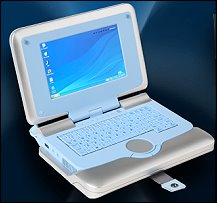
Intel's cheap notebook for education in developing countries


ZDNet reports on an Intel initiative to rival the $100 PC, a notebook called the Classmate PC, to cost around $400. They are aiming to reach out to emerging markets, and have included a range of specific tools for education. It has a handy feature which deactivates the PC if it is removed from the classroom for more than a few days. Some aspects seem very US-centric though, such as the white-list of safe websites for Internet browsing and the reminder to 'pay attention to the professor' if the child clicks onto another page or site. Read the full article.

So now the 100$ laptop has a competitor...

Tuesday, June 13, 2006

Textbooks of the future


"The last time I used textbooks was five years ago," says Paul Bierman, a geology professor at the University of Vermont in Burlington in an interesting article featured in Nature. Others are commenting on the article here in the Nature Newsblog.

Read the full article.

Image by A. Peck.

Tuesday, May 30, 2006

Open source software and open content for education


Together with several colleagues, I recently worked on a project to develop CD-ROMs for schools in Asia-Pacific, full of open source software and open content specifically geared at schools. John T. Denny, Hartfried Schmid and I co-wrote an article for the UNESCO Bangkok newsletter explaining the aims, process and results of this project. Please download the whole newsletter here.

More info available here too.

UNESCO SchoolNet: school collaboration in SE Asia


Early this year I made a move from European Schoolnet to UNESCO SchoolNet in SE Asia. My new project involves managing a network of eight countries: Cambodia, Myanmar, Lao, Vietnam, Philippines, Thailand, Indonesia and Malaysia. The network has been developing ICT-based materials by and for teachers, giving ICT training (both basic skills and ICT pedagogies), encouraging telecollaboration and more. I wrote a full article about it in last month's Digital Learning magazine, and you can download a copy here.

Image copyright: Tinsiri Siribodhi

Friday, May 26, 2006

ICT in education in SE Asia


I recently attended a three day workshop for the launch of the Next Gen project, run by UNESCO in partnership with Microsoft and Cisco. It was an intriguing meeting for many reasons, not only because the project itself is very interesting in that it supports the variety of different needs for improving pre-service teacher training for ICT-based pedagogy, but also because of the common problems faced by many countries. 10 countries took part from Asia-Pacific: India, Sri Lanka, Cambodia, Lao, Thailand, China, Philippines, Indonesia, Malaysia and Vietnam; they each sent a representative from the Ministry of Education, plus a few representatives of teacher training institutions.

So many countries came back to the problem of infrastructure, being stuck at this basic step before reaching the next level. Lack of understanding of technology, and low capacity in Ministries of Education means that it's very hard for countries to 'leapfrog' technologies, and tend to follow old routes rather than innovating and using newer more effective models.

It really made me wonder why more countries aren't involved in the 100 $ laptop project being run by MIT. The laptops are low powered, and have many limitations, but as an alternative to having no technology at all in schools, surely this is an interesting approach? I noticed only Thailand and India have joined the project so far.

A key problem in ICT for many countries is the lack of electricity supply in many rural areas. So I'm particularly intrigued by the project's wind-up laptops. I also think it's a great way to promote open source technologies, as the laptops run Linux and are likely to include open educational content too. I think this can really be the 'Trojan horse' that so many of us talk about in educational reform - David Cavallo (MIT) has written a great paper on education reform.

A final word on the Next Gen launch workshop: the ladies from the Philippines were extremely impressive. Dr. Vilma Labrador from the MoE particularly so. She was the first person I had seen reminding us of the need to have a heartfelt mission for education, and not just be thinking technically or politically. Not only that, but she did parts of her speech in song. Amazing!

Monday, May 22, 2006

Virtual Online Communities


Still the hottest topic on the web, virtual online communities are developing and changing at a rapid rate. I wrote a paper to describe and discuss them, including best practices and emerging trends.
Download my paper

I previously worked together with the webteam implementing online community tools at one of the world-leading school collaboration organisations, European Schoolnet.

Photo by Under Volcano of an artwork from Footprints Community Art Project, Vancouver, Canada.

Tuesday, March 28, 2006

Open source, solar powered ICT to bridge the digital divide


Since I've been working in Bangkok, I've been in contact with many people from countries where schools and communities don't have electricity, let alone Internet connections. At the same time, many development agencies are willing to spend on ICT in education, despite the fact that many schools in countries like Afghanistan or Nepal think that lighting or pens are luxuries! Even in the more well off Asian countries like Thailand, villages and rural areas are still very underequipped.

So I'm very excited to come across this project to offer communications systems to rural and remote communities via solar, hydro or even pedal power. A non-profit organisation, Inveneo, from the USA has launched a new system for villages to get a range of different Internet systems.

"The Communications Station is designed for use by end-users in a village home, school, or clinic setting. It provides computing, telephony and Internet access. The Hub Station is designed for use by a network administrator and is located in a regional location. It is used to manage the network and to provide connectivity to data and voice services," says the press release.

Hardware and software design specs and source code

Monday, March 20, 2006

Campaigning through games


An Italian organisation called Molleindustria makes simple but persuasive games to put across a political or social message. I had great fun playing their McDonalds game, a cartoony "sim" style game, where you have to manage McDonalds' value chain. It's obviously strong on agenda, but rather on the ball, and certainly very funny. Obviously, McDonalds is an easy target, but still a valid one (if you haven't seen Supersize Me, then make sure you do). Surprisingly though, there are still some enlightened souls working for McDonalds, like this manager who converted his cars to run on waste oil from his McDonalds outlets!

Update from New Scientist, strangely echoing part of the game:
"Lowing cattle and sterile fields of soya are replacing Amazonian rainforest so fast that 40 per cent of the forest will be gone by 2050, if present trends continue. Even discounting land cleared for the wood itself, deforestation is threatening ecological meltdown in the region." Full article.

Thursday, March 09, 2006

Carbon offsetting made easy


The marvellous Ditchmonkey reminded me of this great tool for carbon offsetting. You can use the simple calculator tools to work out how much carbon emissions are caused by daily activities or travel, then buy equivalent carbon credits by donating to the site's projects. The projects are in the area of sustainable forestry, renewable energy and energy efficiency. I just used it to offset the carbon emitted by my last plane trip. A brilliant way to use technology for the environment.

Climate Care website

Tuesday, March 07, 2006

Beautiful bacteria


Bacteria self-organising on antibiotic petri dishes look incredible. Just another wonderful example of emergence in action.

More pictures from Pruned

Google Earth & GIS


Despite being the originator of World Wind, NASA is now integrating some of it's data sets with Google Earth. As NASA is having it's core scientific research budget cut (thanks to Bush's marvellous idea of putting people on Mars in the near future), it makes sense for it to maximise budget by using a freely available client side tool such as Google Earth. Existing sources of satellite data in GIS format (for example the US Geological Survey data) can be converted into Google Earth's KML format using Arc2Earth (unfortunately it's not free or open source). Here is a step-by-step guide. This data can then be displayed and navigated via Google Earth. Declan Butler, who reported on this issue in Nature (subscribers only) has created some interesting maps of Avian bird flu incidence using this approach.
More information...

Monday, March 06, 2006

Slime-controlled robots


The ever-fascinating New Scientist reports on a Japanese research team's efforts to control robots using biological organisms, in this case, the slime mould. The slime mould was grown on a circuit, plugged into a PC. The PC then relayed the controls to the robot.

"The Physarum polycephalum slime, which naturally shies away from light, controls the robot's movement so that it too keeps out of light and seeks out dark places in which to hide itself."

Read more