Showing posts with label development. Show all posts

Sunday, September 21, 2008

What happens to the free rice?


People all round the world have been playing Free Rice, a simple but strangely addictive game where you have to identify the correct definition of various English words. It's available from the Free Rice site, as well as via a Facebook app.

Did you ever wonder how they distribute all that Free Rice? Take a look at the video!

Monday, September 15, 2008

Innovative practices in ICT in education in Asia-Pacific


It's always exciting when you see an idea move from thought to reality. The ICT in education team over at UNESCO Bangkok have done just that when they started this award project, to identify teachers and educational planners doing amazing work in ICT in education in the region. The Innovative ICT in Education Prizes These kinds of events are great for inspiring others, and stimulating colleagues to become more innovative themselves. Interestingly, India was far and away the most represented country, despite the quite patchy use of ICT in schools.

I particularly liked the winning example of 'E-tools for Teaching and Learning Geography', from Suryaveer Singh, S.D. Public School, New Delhi, India, which is comparable in standard to projects taking place in Europe that I've evaluated in the eTwinning prizes and eLearning awards. Mr. Singh set up a blog full of quizzes, animations and puzzles, plus kept his class up to date about key dates and events. He also opened a wiki where students could work on their projects together, upload their work, share videos and games, and ask each other questions. He structured their use of the wiki so that they used it as a useful tool in reaching their learning goals. See full details of his project here.

One of the participants in the award ceremony, Rogelio Colting, president of Benguet State University in the Philippines remarked: "We will set up an IT centre in the university to showcase all the innovative ideas applicable in our region. The IT centre will serve as a learning and training centre on ICT applications, particularly to improve teaching at all levels."

The full results are available on the UNESCO Bangkok website.

Monday, September 01, 2008

Food Force: a game about the World Food Program


A great initiative from the UN World Food Programme, the Food Force game helps teach kids about how hunger can affect communities, and how food aid is handled by international agencies.

"Food Force is a free educational video game telling the story of a hunger crisis on the fictitious island of Sheylan. Comprised of 6 mini-games or “missions”, the game takes young players from an initial crisis assessment through to delivery and distribution of food aid, with each sequential mission addressing a particular aspect of this challenging process."

They've also added a special section explaining about food distribution in Myanmar following the typhoon, Nargis.

Play the game here.
Via UNESCO Bangkok.

Friday, May 04, 2007

Google Earth: Crisis in Darfur


I've been following the development of Google Earth with a lot of interest, as it's a great tool for supporting teaching and learning of Earth sciences, biology and geography. Recently Riina Vuorikari pointed out this impressive application, developed by the United States Holocaust Museum and Google. It mashes up data from Google Earth, personal testimonies and maps of settlements from the UN Office for Coordination of Humanitarian Affairs. It's unbelievably striking in conveying the impact of conflict, in a way that we can't grasp via TV news. Take a look.

Thursday, May 03, 2007

Setting up a new school in Cambodia


A previous colleague and now friend John Denny is setting up a new school in Cambodia. I asked him a few questions about what he's up to.

What kind innovative uses of ICT are you putting in place?
"To be honest from my perspective none! But from a Cambodian perspective we are modern as I am pushing all aspects towards digital communications, such as a computer in each classroom. Instead of typical cassette tape listening methods we will use computers to play CD or MP3 versions. Students can then compile listening lessons in MP3 format to play back as they please or cut a CD for home use. I do hope to get some some basic recording equipment so we can upload digital lectures, yet at present stage Internet costliness is a major block in Cambodia as they tend to charge by the MB downloaded. Our school is one of the first to use an unlimited broadband line! We have a satellite connection beamed in from one of [Thaksin - ex-PM of Thailand] Shinawatra's floating beasts. Thus I will encourage massive downloading - something new for Cambodians."

What's been the biggest challenge in setting up the school?
"First I thought it was to create a unique identity as language schools are a dime a dozen here. Thus it has taken considerable thought coming up with a doable plan that will attract students while giving them the security they need. We intend to offer a quality program second to none."

"On second thought offering a quality program is a struggle. Getting highly motivated teachers, school staff and connected issue of creating a ""culture of quality" institution-wide is not an easy task. It is a major struggle dealing with my developed world sensibilities versus the reality that in a post-conflict country things simply do not and cannot work the way one knows they should."

What would be the dream 'killer app' for helping the school, whether pedagogical, admin or something else?

"That's an easy one. I am dying to get a web-based open source school management app installed and configured. My target is OpenAdmin, if that fails Focus/SIS or CLaSS. Whatever it is, I am desperate to consolidate all school management function in one web app. Yet the bigger struggle is to get largely non computer literate staff members to understand the importance and buy-in after it is installed."

What's the local reaction like?
"So far we have distributed about 10,000 brochures. I was instrumental in totally reconfiguring the marketing strategy set by our school director. Instead of paying media corporations to advertise our school I convinced the team to advertise for commission-based sales representatives. These sales reps are given brief training on school selling points then set afoot to broadcast the message. Any student enrollment generated by the sales rep then brings them a 10% sales commission. After bringing in 6 students a sales rep is awarded an extra bonus or the chance to enroll for free in any of our course offerings."

"As per several of the highly motivated sales reps the reception is excited and enthusiastic as they can see via our brochure that this school strives to be different, is going to be a value added experience -- the type of place where students come to develop a lifelong experience in learning and sharing ( i.e. 3 NGO's on premises; special workshops, lectures and seminars, free overseas study advise, free software distribution, etc...)"

The website is still under construction, but visit: http://www.princeacademy.org

Friday, December 01, 2006

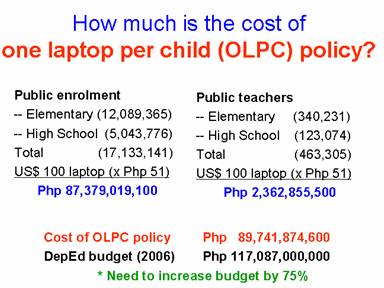
One laptop per child is unfeasible for developing countries


I have been following with great interest the development of the MIT $100 laptop project, as it seems to have good potential for developing countries. Benjamin Vergel de Dios, UNESCO Bangkok, made a financial simulation of the costs of equipping every child in the Philippines with a $100 laptop. As you can see in his diagram, it implies increasing ICT budget by a 75%, which is unfeasible for most developing countries. Benjamin is coordinating on an excellent project, called ICT in Education Policy, which aims to "promote appropriate policy models and strategies for the integration of ICT into education in the Asia-Pacific region, with special emphasis on developing policies which utilize ICT to remove barriers to participation in education and enhance the quality of education".

Image: Benjamin Vergel de Dios