At the EU Media seminar, one of the speakers showed this amusing video to raise awareness of children's web-use among parents.
Showing posts with label Internet. Show all posts
Showing posts with label Internet. Show all posts
Friday, May 11, 2007
Tuesday, November 07, 2006
Lessons from an unusual social network
In the English speaking world, teenagers are all busy chatting to their friends on commercial social networking platforms, like MySpace (owned by News International) and Bebo. These platforms are full of advertising and offer little in terms of child protection or safety. Meanwhile many French speakers are using a rather unique platform, set up by a non-profit organisation, called Parano.be. Although it's based on rather basic technology (php), it has a huge number of users and survives on donations made by the biggest fans of the site. There is no advertising at all. Members join specific sectors based on their interests, which include sector-specific forums, bulletin boards and a number of other features. A virtual 'salary' is provided to users based on how long they stay online; the currency can be used to purchase virtual gifts or services for others, or even transferred directly to others' virtual accounts. The network is essentially organic: to invite a new member, you have to spend a relatively large sum of virtual currency to send the invite.
Here are some of the most intriguing features from an educational point of view:
- child safety is maintained. Under 18s can only join and view certain sectors of the site, which are monitored by older, verified individuals. Occasionally younger members will lie about their age, but the community usually swiftly responds. There is a high level of responsibility and self-policing. It shows that a school-based community could effectively be moderated by older children.
- role play (RP) is pervasive: although the interface is largely text based, RP is part of the life of most sectors on the discussion forums. The moderators organise an RP session on a regular basis, based on the suggestions of the members. These RP sessions are basically long stories generated by the contributions of each user, and can be highly imaginative. In education, such an approach would be great to encourage creativity and written expression.
- rank changes according to behaviour: the moderators assess the level of participation and other issues to understand what rank the members should have. Usually enthusiastic members will rapidly rise in rank, unlocking new features and 'missions' to complete. This is an interesting 'game style' approach which could encourage pupils to use a system.
- virtual currency is usually spent solidifying social links: buying virtual gifts such as champagne, flowers, teddy bears, etc. for others is really important in keeping good relationships with other members. Such a system could be used in a school-oriented scenario to help individuals understand money management and mathematics.
- games are common: individuals will organise games or competitions from their profiles. They could be treasure hunts, to find information hidden on others' profiles, or simple trivia questions. Prizes are usually virtual currency or gifts. This ludic atmosphere could easily be transferred into an educational 'quest'.
Here are some of the most intriguing features from an educational point of view:
- child safety is maintained. Under 18s can only join and view certain sectors of the site, which are monitored by older, verified individuals. Occasionally younger members will lie about their age, but the community usually swiftly responds. There is a high level of responsibility and self-policing. It shows that a school-based community could effectively be moderated by older children.
- role play (RP) is pervasive: although the interface is largely text based, RP is part of the life of most sectors on the discussion forums. The moderators organise an RP session on a regular basis, based on the suggestions of the members. These RP sessions are basically long stories generated by the contributions of each user, and can be highly imaginative. In education, such an approach would be great to encourage creativity and written expression.
- rank changes according to behaviour: the moderators assess the level of participation and other issues to understand what rank the members should have. Usually enthusiastic members will rapidly rise in rank, unlocking new features and 'missions' to complete. This is an interesting 'game style' approach which could encourage pupils to use a system.
- virtual currency is usually spent solidifying social links: buying virtual gifts such as champagne, flowers, teddy bears, etc. for others is really important in keeping good relationships with other members. Such a system could be used in a school-oriented scenario to help individuals understand money management and mathematics.
- games are common: individuals will organise games or competitions from their profiles. They could be treasure hunts, to find information hidden on others' profiles, or simple trivia questions. Prizes are usually virtual currency or gifts. This ludic atmosphere could easily be transferred into an educational 'quest'.


Friday, October 20, 2006
Digital teenagers
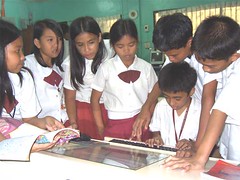
A recent post on David Warlick's 2 Cents Worth blog pointed me in the direction of a recorded interview with a bunch of American teenagers about their Internet habits, which took place at the 2005 web 2.0 conference. I found it particularly interesting, as I realised that my own Internet habits were pretty similar to the teenagers. Here are some of the main points that struck me:
- teenagers spend a great deal of time on MySpace or similar social networks. I visit MySpace once daily, although don't spend as long on there as they do - but I'm using alternative spaces for similar activities.
- they are really into IM, via whatever interface is used by most of their friends. I only recently managed to get off IM (mainly to save myself time, as I often got into distracting conversations in the middle of the day), although in a previous job I used IM extensively to chat with web developers
- they don't want to pay for things, and use P2P networks on a regular basis. Me too!
My conclusion is that we need to look more into the following areas in education:
- Internet safety for teens: how to protect them through education and media literacy
- IM for education: there are obvious applications in language teaching (linking up pairs of students across borders to chat in second languages) but how else could it be used?
- P2P educational resources: in education, we often say that we want teachers to share resources, but still put up barriers to students doing this. Shouldn't we allow students to share/learn from each other in this way too?
Subscribe to:
Posts (Atom)
