Thursday, November 30, 2006

Augmented reality and mobile learning


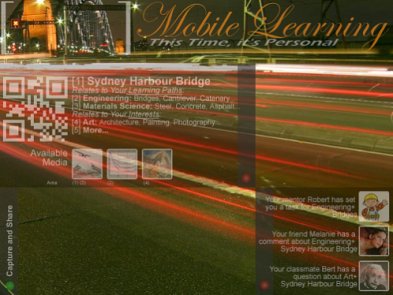
Leonard Low, who publishes the Mobile Learning blog recently posted an interesting concept for mobile learning interfaces. His idea is to have a flexible LCD screen which picks up location-based educational data via a mobile device. The student would then be able to access online resources and contacts according to his/her location, as an overlay of the view of the location itself.


As an aside, I think this is another illustration of the innovative nature of fiction - the overlay-style view he proposes looks rather similar to 'Terminator Vision' in James Cameron's 1984 Terminator movie.

Image by Leonard Low.

Thursday, November 23, 2006

Passively Multiplayer Online Games for Schools?


Howard Rheingold just blogged about Justin Hall's presentation at the University of South California's Annenenberg centre.

Howard wrote:
"Justin has fun online, works online, studies and loves and plays online -- and on his phone and his Playstation. Why can't the whole thing be a game -- a social game and a knowledge game? While he goes about his day's surfing, blogging, chatting, tagging, gaming, posting, uploading, downloading, Justin wants to experience the same visible sense of goal-oriented progress he gets in World of Warcraft when he looks at his screens and sees exactly what level his activities have earned him."

He also mocked up a screenshot using Jaiku, which I am using here to illustrate this post.

He also posted a link to a video (Quicktime) in which Justin explains the concept.

This kind of concept would also be great for learning environments, allowing users to understand how much progress they have made in different areas of their work. It's easy to see how it could be added to an LMS system such as Moodle for instance. Only problem is, it's inherently quantitative (i.e. will measure time and/or number of contacts, posts, etc) but would be unable to deal with qualitative aspects.

Wednesday, November 22, 2006

Social software and learning


Futurelab, a great UK-based research organisation working on many exciting research projects in education technology. It's launched a series of useful publications on current hot topics, called Opening Education . They recently published 'Social Software and Learning (PDF)', an excellent overview of social software, implications of such software for education, plus a plan of action for moving towards community-based learning.

Tuesday, November 14, 2006

Games in education


Computer games are becoming more and more popular in the educational world. UNICEF has just released Ayiti - The Cost of Life (via Water Cooler Games), a simplified 'Sims' style game where you assign tasks to family members living in Haiti. Even playing for just a few minutes communicates how difficult it is to balance health, education and finances when you are affected by poverty. Although I enjoy games, and see that they have some classroom uses, I think there's a lot of hype around them at the moment.

Obviously games have a lot of potential:
  • creating innovative interfaces for accessing educational content - mashing up Moodle with Second Life (SL) in Sloodle, so that content can be transferred and published on both platforms (more info on SL & education here)

  • increasing student motivation - using a new kind of interface can stimulate students' enthusiasm

  • improving hand eye coordination and reaction time - these are particularly crucial in fast-paced games.

I don't subscribe to the media hysteria of 'games are evil' (check out this interesting article on the topic from the Wilson Quarterly), I do see a number of issues in using games in education:
  • gender - navigation in virtual spaces has some gender issues; often boys find it easier to navigate due to more experience in game environments. Representation of gender roles in games can also be highly stereotypical, presumably because of the skewed gender representation in the technology industry

  • hampering creativity - some innovative games such as Sims and SL allow users to transform and create during the game. However, most still rely on users following one of a number of pre-determined paths, thus reducing creative opportunities.

  • difficulty and expense of game development - commercial games are now often more expensive to produce than Hollywood movies, and thus to produce an educational game of similar quality to the entertainment sector is prohibitively expensive.


More info about games in education:
Report from the Summit on Educational Games
University of British Columbia's virtual campus on SL
A collection of research papers on games in education on Citeulike
DoomEd - a first-person shooter game for science education.

Global nomads: video conferencing


An article in Edutopia covered the Global Nomads project, which aims to get teenagers to get in touch with their peers across international borders. The school pupils get to meet via video conference, and discuss crucial topics such as HIV/AIDS, global warming and war. But it's not all school work: the students also get a chance to ask questions about family life and hobbies. The website includes a media library of short films from Vietnam, Brazil, Japan and many other countries, and a schedule of forthcoming video conferences.

Tuesday, November 07, 2006

Lessons from an unusual social network

In the English speaking world, teenagers are all busy chatting to their friends on commercial social networking platforms, like MySpace (owned by News International) and Bebo. These platforms are full of advertising and offer little in terms of child protection or safety. Meanwhile many French speakers are using a rather unique platform, set up by a non-profit organisation, called Parano.be. Although it's based on rather basic technology (php), it has a huge number of users and survives on donations made by the biggest fans of the site. There is no advertising at all. Members join specific sectors based on their interests, which include sector-specific forums, bulletin boards and a number of other features. A virtual 'salary' is provided to users based on how long they stay online; the currency can be used to purchase virtual gifts or services for others, or even transferred directly to others' virtual accounts. The network is essentially organic: to invite a new member, you have to spend a relatively large sum of virtual currency to send the invite.

Here are some of the most intriguing features from an educational point of view:
- child safety is maintained. Under 18s can only join and view certain sectors of the site, which are monitored by older, verified individuals. Occasionally younger members will lie about their age, but the community usually swiftly responds. There is a high level of responsibility and self-policing. It shows that a school-based community could effectively be moderated by older children.
- role play (RP) is pervasive: although the interface is largely text based, RP is part of the life of most sectors on the discussion forums. The moderators organise an RP session on a regular basis, based on the suggestions of the members. These RP sessions are basically long stories generated by the contributions of each user, and can be highly imaginative. In education, such an approach would be great to encourage creativity and written expression.
- rank changes according to behaviour: the moderators assess the level of participation and other issues to understand what rank the members should have. Usually enthusiastic members will rapidly rise in rank, unlocking new features and 'missions' to complete. This is an interesting 'game style' approach which could encourage pupils to use a system.
- virtual currency is usually spent solidifying social links: buying virtual gifts such as champagne, flowers, teddy bears, etc. for others is really important in keeping good relationships with other members. Such a system could be used in a school-oriented scenario to help individuals understand money management and mathematics.
- games are common: individuals will organise games or competitions from their profiles. They could be treasure hunts, to find information hidden on others' profiles, or simple trivia questions. Prizes are usually virtual currency or gifts. This ludic atmosphere could easily be transferred into an educational 'quest'.

Friday, November 03, 2006

Football, global thinking and ICT in the holidays


The Communication Initiative recently published an article which alerted me to Bring on the World, a pack of excellent ICT-based resources for informal education activities for school breaks. Using the World Cup as a basis for exploration, this pack of activities released by Oxfam helps children to think and learn about fair trade, globalisation, Millenium Development Goals and other huminatarian topics. At the same time, the activities are linked to the UK curriculum, as they involve PE, English (reading and writing), Geography, Citizenship and ICT.

Picture from Oxfam website.

Thursday, November 02, 2006

Open source learning resources repository


Not all schools or other educational institutions need or want to install a learning management system (LMS), but a learning resource repository is extremely useful for keeping track of digital learning resources and better enabling sharing between teachers and learners. European Schoolnet has recently released MINOR, an open source "repository to store, manage, and exchange the multimedia assets produced by teachers", as it says in the news article they recently published. The application and source code can be downloaded from Sourceforge.

eLearning for developing countries: what's needed?


Despite many good intentions for developing countries to 'leapfrog' in technical terms, it is rarely yet the case. In many ways, this is because most technologies are designed and deployed in a developed country context, and thus have a number of limitations when trying to implement in a developing country. Additionally, many developing countries still don't have many specialists in ICT in education, and rely mainly on the precious few of enthusiastic, over-worked, pioneering teachers to drive change in their schools.

My work in SE Asia and Europe has prompted me to identify some issues which might help developing countries to deploy more cutting edge technologies in schools, despite the status quo of low bandwidth, poor infrastructure, low levels of training and support for teachers.

1. LAN-based Learning Management System (LMS) installation

many LMS have excellent features which would help schools in developing countries to make best use of their low levels of connectivity and relatively few ICT-based resources. Using an LMS with some learning content management features on a LAN is a good solution for enabling teachers to effectively share their 'homegrown' as well as externally acquired ICT resources. In addition, using LMS tools would enable students to get a 'feel' of using Internet-style applications without the need for broadband connectivity.

What are the barriers? Cost (especially in the case of commercial LMS), difficulty of installation (particularly in Open Source LMS), need for low cost LMS on appropriate platform (many low cost LMS run on Linux, which many teachers find hard to install).


2. Platforms based on mobile phone technologies

Many developing countries have very low numbers of PCs in schools, and low connectivity. However, many people are using mobile phones, and I have seen that many teachers have their own. In Thailand for instance, many people have mobile phones with quite advanced features. There is clearly potential for using mobile phones for teacher support and networking - e.g. sharing lesson plans, tips and advice. My previous post on mobile learning has other ideas.
What are the barriers? Lack of models for use of such platforms, lack of knowledge among teachers in installing/configuring such platforms.

3. Platforms with a range of content creation and synchronisation options
Due to low connectivity, schools in developing countries can benefit from platforms which can deal with offline content creation, which can synchronise/upload/download new resources and other content in a batch process. Surely RSS/XML technologies can handle this rather easily.
What are the barriers? Barriers are almost non-existent. Are there platforms out there already which have these capabilities?

4. Open content repositories with language agnostic approach Many educators in developing countries say that there is little content available in their languages. However, there are huge amounts of language-free content online in the form of pictures, maps, small sound files and other non-textual forms. But teachers and students cannot find such content due to the lack of index and search tools available in their own languages. It would be great to see more organisations taking a FOSS/OER approach to translating at least search interfaces in minority languages.
What are the barriers? Lack of capacity within developing countries to take the initiative on such issues, lack of awareness in developed countries to make such facilities available.

5. Training in dealing with low ICT infrastructure scenarios Many teachers in developing countries seem to think that they can only really use ICT if they have one or two pupils per computer in the computer lab. There are many strategies for using ICT without having a good level of infrastructure. For instance, I saw in one training session, Chris Smith using just one keyboard and mouse together with a projection screen to engage a whole group. Basically, one person controlled the mouse, and another the keyboard. Both were passed around the room so that everyone used the equipment during the session - the only additional investment needed was a very long (but cheap) cable! Other strategies such as using web applications on a LAN, backing up websites using tracker programes (like HTTracker) so they can be browsed offline when Internet connection is slow or disconnects often. There are many other strategies, but hardly any training or training content for teachers on this topic.
What are the barriers? Most training is planned still with an "ideal" situation in mind rather than a realistic view of the state of schools. Better needs analysis should be done when planning training.
Tuesday, October 24, 2006

What MySpace can teach education technologists


MySpace, the site that most Western teenagers use every day, but also love to hate. It has so many problems and issues, but nonetheless continues to grow in popularity. Perhaps there are some lessons we can learn for education technology projects.

1) Users can tolerate bugs: Myspace is bug-ridden. This morning I had to log in 10 times to subscribe to a friend's blog. But people still go there every day..
2) All that matters is the people: Most users only stay on MySpace because their friends and useful contacts are there.
3) Safety is not assured: although still affecting a relatively small number, safety concerns are high (as anyone can register, and say they are any age). So adults can send unsuitable content to children.
4) Privacy worries: teens are posting unsuitable content, without thinking about the consequences. There's clearly need for more media literacy education here.
5) Usability isn't such a big deal: the MySpace interface is very inefficient and requires far too much clicking to do some simple tasks. But they still go back...
6) Corporate ownership doesn't worry them: teens are uploading creative work to the MySpace platform without any concerns about ownership.

US researcher Danah Boyd has written a great deal about MySpace and similar social networks. Also my previous post on digital teenagers has some discussion of similar issues, and a link to an audio file which includes teens talking about MySpace.

Friday, October 20, 2006

Digital teenagers


A recent post on David Warlick's 2 Cents Worth blog pointed me in the direction of a recorded interview with a bunch of American teenagers about their Internet habits, which took place at the 2005 web 2.0 conference. I found it particularly interesting, as I realised that my own Internet habits were pretty similar to the teenagers. Here are some of the main points that struck me:
- teenagers spend a great deal of time on MySpace or similar social networks. I visit MySpace once daily, although don't spend as long on there as they do - but I'm using alternative spaces for similar activities.
- they are really into IM, via whatever interface is used by most of their friends. I only recently managed to get off IM (mainly to save myself time, as I often got into distracting conversations in the middle of the day), although in a previous job I used IM extensively to chat with web developers
- they don't want to pay for things, and use P2P networks on a regular basis. Me too!

My conclusion is that we need to look more into the following areas in education:
- Internet safety for teens: how to protect them through education and media literacy
- IM for education: there are obvious applications in language teaching (linking up pairs of students across borders to chat in second languages) but how else could it be used?
- P2P educational resources: in education, we often say that we want teachers to share resources, but still put up barriers to students doing this. Shouldn't we allow students to share/learn from each other in this way too?

Wednesday, October 18, 2006

Postcode plants database


The UK's Natural History Museum offers this excellent resource for the UK. You simply fill in the first part of a UK postcode in the search box, and the database returns a list of native flora from that area. The species are listed under both common and scientific names, and clicking on the species gives a few additional details such as the family, form, provenance and in many cases, some photographs. The database could inspire many different educational activities, such as comparing and contrasting species found in two or more areas of the country, providing a "jumping off" point for outdoor investigations, where children could map the frequency and location of particular species in the local area. The possibilities are really only limited by the imagination. Unfortunately the database is copyright to the Natural History Museum - it would be great to see this as a Creative Commons licensed resource. It's a nice initiative that could be widened to a global scale.

Update (19/10/2006): this morning I read Stephen Downes' post, re-emphasising the value of P2P infrastructures compared to client-server approaches. It made me re-think the value of this kind of postcode database. It would be even better if there were open contribution databases, with feeds which could be federated into one... Then, students could be contributors and constructors of the resource, rather than just users.

Google and Oracle make further moves in education


Both companies have recently announced new initiatives for education. Google have partnered with a number of educational organisations (mostly US based) to provide examples and advice for teachers around a number of their tools. They now have a specific website for educators bringing together the tools and content.


Meanwhile the Oracle Academy has a new curriculum for secondary school students in advanced ICT, and new training materials for teachers. There is an overview (PDF) posted on the site. It seems like a more formal approach to complement the existing informal learning project I previously blogged about, Thinkquest.

Photo by Marvin.

Tuesday, October 17, 2006

Thinkquest Thailand


Oracle's Thinkquest competition for students is taking place again this year. So far, only one Thai team has taken part in the past. This year, three teams will join in the competition, and thanks to Dr. Rangsun at the Thai Bureau of ICT, I have the chance to support them. Dr. Rangsun organised a great one-day workshop, where the teams of students and teacher-coaches presented their ideas so far, and received constructive criticism from Oracle experts, Dr. Rangsun and myself. Now, the teams are supporting each other via a discussion list. I look forward to seeing the results!

Friday, October 13, 2006

Making connections through images: Memory Project


No Man's Blog recently introduced me to the Memory Project, a really wonderful small-scale project linking high school students in Western countries with disadvantaged kids in developing countries. The high school students are studying art, and are asked to make a portrait of their distant counterpart. As it says on the site/
"Given that children who have been abandoned, neglected, abused, or orphaned usually have few personal keepsakes, the purpose of the portraits is to provide them with a special memory of their youth and to help honor their heritage and identity".

It would be great to see this project enlarged, so that there is a long term means of contact between the two groups. Adding an ICT-based element for maintaining contact would then also act as an informal training mechanism for the children in the developing country.

Thursday, September 21, 2006

Mobile learning


I've often thought that mobile learning is going to be an even more exciting development than traditional eLearning. Even in developing countries, mobile phones are well used (here in Thailand, I'm often embarrassed by how old my phone is compared to the young people on the SkyTrain). So their potential for unlocking a much more accessible approach for education is huge.

There is some interesting work going on in Europe, based on mobile phones. Lots of ideas are flying around like pervasive educational games for pupils, on-demand tutoring/mentoring for university students, making interactive location-based content using the mobile version of the Flash application...

There is a good research project, called emapps.com which has among its goals:
  • "adaptable interactive tools (primarily games played on a mobile platform) with which to deliver learning objectives and which help to integrate the use of ICT in the delivery of the school curriculum;"

  • "to build communities of creative, networking children in the NMS, generating their own cultural content and communicating with peer groups in other countries"

  • "to make the multilingual and multicultural local content created during the games to be shared and repurposed for use in the wider eLearning context of schools and children".


Futurelab is an excellent UK research centre for ICT in education. They have produced a report called "Literature Review in Mobile Technologies and Learning" which includes a number of casestudies.

Ericsson, the mobile phone company is doing some research on m-learning, and offers a nice overview presentation (PDF) and also an update on main EU activities in this area.

Mobilearn is a large scale EU project led by Giunti(an Italian LMS & multimedia company). The project has made available a great deal of handy resources.

Finally, I also came across Mobile Learning, a good blog keeping up to date on the issues.

Update (17/10/2006): I met with Teemu Leionen from FLOSSE Posse in Bangkok a few weeks ago, and he let me know about the MobilEd project, which is doing some interesting experiments using mobile wikis in low connectivity contexts in S. Africa.

Update (3/11/2006): Howard Rheingold recently posted about free mobile phones for teenagers supported by advertising in Finland. It would be interesting to see a similar initiative in developing countries.

Photo by Donknuth.

Tuesday, September 12, 2006

Open content for education


Educational content is still too expensive and inaccessible for many developing countries, whether it is digital or traditional. As connectivity rates increase dramatically, it makes sense to prepare digital materials for these newly connected educational institutes, teachers and young people. There are a number of interesting projects worldwide to do this, including the Global Text Book project, aiming to "create a free library of 1,000 electronic textbooks for students in the developing world". These textbooks will cover areas typically included in the first two years of undergraduate study - I'm sure many developed world students will use them too.

Another interesting approach comes from the Centre for Open and Sustainable Learning, part of the Utah State University in the USA. They are involved in a range of projects such as Creative Commons for Education, creative learning environments using advanced visualisation, and open course ware (OCW). Even better, all their materials are CC licensed too.

Wikieducator is also part of the whole open content movement, acting as a hub for those interested in this area. The portal itself hosts free content for education, and the people behind it network to find ways of funding open content projects. Meanwhile the Bazaar is a similar approach, but a wider scope, as it's a community for exchange and use of both open content and free & open source (FOSS) software.

The University of Art and Design Helsinki has recently collaborated with UNESCO to offer the Young Digital Creators kit, a free kit for schools and other educational organisations, which includes a variety of approaches, tips and more for helping young people to make creative content. To support the activity, the kit includes a number of FOSS tools. UNESCO also has another project for producing CDs of FOSS tools and open content for education, which I previously blogged about here.

Finally, the mother of all open content projects, Creative Commons has a great archive of materials and useful advice for licensing your content in more open ways.

Update (24/10/2006): UNESCO's Virtual University project hosts a number of online discussions of Open Educational Resources for Higher Education.

Friday, September 08, 2006

Learning Management Systems: the next move


As usual I've been keeping my eye on the current research in Learning Management Systems (LMS) and their other incarnation, Personalised Learning Environments (PLEs). I recently came across this article - Social software: E-learning beyond learning management systems - which unifies two areas I'm into: social networks and LMS. As a student, I have used a very basic LMS, but really only for accessing archived materials put online by tutors. As a real-life learner, I don't really use LMS-type software but I do use social networks and I'm an avid consumer of all collective intelligence-type stuff like Diigo and Technorati. However, all this changes week to week. If we take into account multiple intelligence theory, and combine this with the budget limitations faced by education, it becomes clear that a really good PLE is probably not achievable, unless the student has almost infinite control on the look and feel (or even sound!) of the PLE, the speed of new data update/transfer (for instance I love to be interrupted, I find it inspiring, while others find it counterproductive) and even the kinds of communication tools he/she needs.

But do we need one unified system to provide all this? Or should we just be flexible and open to the needs of individual students? On one hand, the unified system is attractive because it is safe and controllable, but this also limits its flexibility and potential. Meanwhile, a truly open 'free for all' approach can customise for any student, but is likely to be low on child protection and guidance for those who need it. Maybe the answer is we need both?

In any case, in a developing world context, the whole debate is still more open, as few schools are using LMS. Some well-off universities have bought into commercial LMS like Blackboard, but it's really the exception. So, should we be advising developing countries to implement LMS? The concensus here seems to be that we should, and probably focus on Moodle as it is relatively low cost. But for a small school, with low numbers of computers, this is surely overkill and it's better to look at a PLE type setup.

Photo by Alexa Joyce

Friday, August 11, 2006

Web 2.0, blogs and RSS


I recently presented twice about web 2.0, blogs and RSS to a bunch of colleagues working as web editors at UNESCO. Take a look at the powerpoint here.

Technorati Tags: , , ,

Thursday, August 03, 2006

More Google Earth...


An interesting article from the German magazine on how Google Earth is changing science - in English.

Photo by EUMETSAT from European Space Agency.