Monday, September 01, 2008

Food Force: a game about the World Food Program


A great initiative from the UN World Food Programme, the Food Force game helps teach kids about how hunger can affect communities, and how food aid is handled by international agencies.

"Food Force is a free educational video game telling the story of a hunger crisis on the fictitious island of Sheylan. Comprised of 6 mini-games or “missions”, the game takes young players from an initial crisis assessment through to delivery and distribution of food aid, with each sequential mission addressing a particular aspect of this challenging process."

They've also added a special section explaining about food distribution in Myanmar following the typhoon, Nargis.

Play the game here.
Via UNESCO Bangkok.

Wednesday, August 27, 2008

Asia-Europe Classroom cooperation

A while back I had the chance to meet Ramon Molina from the Asia-Europe Foundation (ASEF). He introduced me to an interesting initiative run by ASEF, the Asia-Europe Classroom. It's still relatively small scale, but shows just what can be done when students and teachers from two continents work together.

The latest new project is 'Citizens of the World', "an interdisciplinary project which encompasses Culture, Science, History, and Sports." Students from the schools involved are asked to pick the most important citizen from their own country, and present them to their partners in other countries. It's a wonderfully simple but effective way to help young people understand and value both their own heritage, as well as their partners' heritage.

A conference for teachers involved in the project is taking place in December, in Malaysia.

Tuesday, August 26, 2008

Glance at a country: Thailand


Thailand has been active in ICT in education for many years now, and some schools are already very well equipped. One school I remember particularly well from my visit is Suankularb school in Nonthaburi, just outside Bangkok. They have a great deal of computers, and the students there have used them in a variety of contexts (language and science lessons), as well as developing their skills in computer graphics. They also take part in numerous UNESCO projects such as the Schoolnet project.


On an institutional level, the National Electronics and Computer Technology Centre (NECTEC) is responsible for all kinds of ICT development in Thailand (see the English version of the website, no longer updated)

Schoolnet Thailand (English version) is the national gateway for schools. It includes blogs, recent articles on different topics, a library of teaching resources and more. It's provided by the Thai Bureau of ICT, part of the Ministry of Education.

Intel's Thai Skoool site is an online classroom for maths and science. It provides study notes and services for maths, biology, chemistry, physics and earth science. It's a collaborative project with the Thai Ministry of Education and Microsoft.

Photo credit: Hartfried Schmidt

Sunday, August 24, 2008

Edublogger 08: helping kids become researchers


My post on science education has just been published over at the Supercoolschool blog. Here's an extract:

"Many kids find learning science dull and boring - but research (for example, the Rocard report) indicates that hands-on science, where kids "become" scientists in the classroom through inquiry-based techniques helps overcome this perception. By inquiry-based science education, we mean processes where children are investigating issues that they find interesting, and even designing their own experiments to help them verify hypotheses."

Check out the rest of the post and join the debate at:
http://supercoolschool.typepad.com/blog/edublogger_event08/

Wednesday, August 20, 2008

Education 3.0 at school: the case of eTwinning


Derek Keats and Philipp J. Schmidt, both active on the UNESCO OER list, have just published a new paper in First Monday, 'The genesis and emergence of Education 3.0 in higher education and its potential for Africa.'

From their point of view, "Education 1.0 is mainly a one-way process, Education 2.0 uses the technologies of Web 2.0 to create more interactive education but largely within the constraints of Education 1.0. Education 2.0 is laying the groundwork for Education 3.0, which we believe will see a breakdown of most of the boundaries, imposed or otherwise within education, to create a much more free and open system focused on learning."

This gives me a lot of hope. In many ways, school education is already heading towards this state, and eTwinning is helping it to happen. Schools in Europe are cooperating informally, and have generated these 'peer to peer' partnerships, which aren't institutionalised or funded. They are sustained purely on the basis of the enthusiasm of students and teachers for the projects.

Let's take a look at how it measures up, against their typology:

a) Role of professor (teacher): Orchestrator of collaborative knowledge creation
This is already the case in eTwinning. Most of the projects I've seen in the eTwinning prizes are almost entirely built by students. Teachers provide the framework and schedule, while students develop all the results together. In some cases, the students even choose the topics to cover, and teachers decide on the pedagogical method and schedule.

b) Free/open educational resources created and reused by students across multiple institutions, disciplines, nations, supplemented by original materials created for them
Most of the work developed by students is based on free, easily accessible content that they have found online - although of course, some still rely on books (however I see this as a strength to combine old and new media). The results of their work - in a way new educational resources - are almost always made available online and for free.

c) Open, flexible learning activities that focus on creating room for student creativity; social networking outside traditional boundaries of discipline, institution, nation
This is definitely happening in eTwinning. Students often go beyond the required activities set by their teachers, and communicate readily with their partners via online tools such as MSN or Skype. However it might be extended in future to include other kinds of actors (e.g. museum staff) rather than only other pupils and teachers, but this isn't currently in the main plan of eTwinning unfortunately.


d)Loose institutional affiliations and relations; entry of new institutions that provide [higher] education services; regional and institutional boundaries breakdown
Again, schools are already affiliating in this way through eTwinning. However, the entry of new institutions isn't so evident. Most of the institutions active in eTwinning are those that you might expect (e.g. Ministries of Education, agencies like the British Council). Also, most schools will rely principally on their own national agency for support, rather than asking for support from another country. The exception to this rule is the Central Support Service - European Schoolnet - in Brussels, which offers services to teachers in any of the eTwinning countries.

e) Active, strong sense of ownership of own education, co-creation of resources and opportunities, active choice
Students are already co-creating resources and processes in eTwinning, and even choosing the topic of cooperative work. However, how far the ownership issue has progressed really depends on the teacher: if he/she is able to 'let go' and put students in the driving seat.

f) E-learning driven from the perspective of personal distributed learning environments; consisting of a portfolio of applications

Although the eTwinning portal offers a suite of tools and services to run the projects, teachers and students are free to add other tools to their portfolio. Many are using other platforms such as Ning, Blogger and Flickr, post videos to YouTube or distribute their own podcasts. The new eTwinning platform (scheduled for release in October this year) will place even more emphasis on the suite of web 2.0 tools that teachers are already using, and will be more based on standards such as Open ID and RSS, so that they can import/export content more easily across these different platforms.

Tuesday, August 19, 2008

Tell us about games at school!

I'm working on the 'games in schools' project, and looking for teachers interested in the topic to tell more about their place at school.

Respondents can win X-box 360 Elites and a pack of child-friendly games by filling in the survey!

"Adventure games, role plays, arcade, strategy games, simulations, driving games, puzzles, brain gym … We hear more and more about computer games and they are getting more and more sophisticated, but what is their place in school? Are they useful or dangerous? Opinions among teachers seem to be divided with some enthusiastic teachers using them effectively, some sceptical and some hostile. What is your opinion?"

Online survey in English, French and German:
Games in school survey
Enquete sur les jeux video
Umfrage zu Spielen in Schulen

Downloadable survey as a Word file for return by email to gis@eun.org:
Danish
English
Estonian
Italian
Lithuanian
Spanish


Photo credit: dominic

Monday, August 18, 2008

Join the Edublogger event on 23 August!


Max Senges of Supercoolschool kindly invited me to join the Edublogger event 08! Here's how he describes it:

"Edubloggerevent08 Building on the success of last years EduBlogger event, we are proud to organize "EduBlogging Event 08" next month on Saturday the 23rd of August!
12 bloggers involved in new education projects will publish a text or video post about their take of an aspect of education & new technologies on our blog and All of you are invited to engage in a vivid Q&A session and discussion afterwards."

Tuesday, March 25, 2008

400 eTwinning teachers meet in Romania


The week before Easter the annual eTwinning conference took place. The whole event was really exciting, with lots of great presentations, and the keynote speaker, Sugata Mitra of 'hole in the wall computer' fame went down a storm with his message that children can learn anything if they really want to.

We set up a team blog to cover the event - the bloggers are shown discussing in the photo (by Cecile Gouzee, French-speaking Belgian NSS). On the blog you can find out more about the exhibitions, workshops and plenary sessions, including the powerpoints.

Wednesday, February 20, 2008

Mexican Student Builds Eco-Video Game

via TreeHugger on 19/02/08

ship-shop-video-game.jpg Photo credit: ITESO
José Carlos Rivera, a student studying computer science at the Western Institute of Technology and Higher Education in the city of Guadalajara, has designed a game entitled Ship Shop, offering players a kind of eco-justice perhaps unattainable in the real world, according to the Mexican daily Reforma. In the game, the hero tries to vanquish polluting criminals, and while he's completing the mission the player is edified by pop-up tips ...

Thursday, February 14, 2008

Video clip for Safer Internet Day


More info on Safer Internet: www.saferinternet.org

New guide for parents and children on Internet safety: http://www.webwise.ie/GenPDF.aspx?id=2339

Wednesday, February 13, 2008

LeMill - European community of learning resources growing

Via FLOSSE Posse I heard that LeMill, the European community of learning resources has now reached 2,000 members.

Interestingly, Teemu states 'The growth is not created by the citizens of the wealthy "old Europe" (France, Germany, UK, Netherlands, Sweden, Finland, etc.) but by the new Europe: the Baltic countries and the Eastern European countries."


Hans’ and Tarmo’s LeMill presentation for Czech teachers in Brno, Czech Republic on February 7th 2008.

Teemu's statement mirrors what I observe in educational projects run by European Schoolnet. Teachers from the new member states are keen to try new approaches and get involved in international learning communities. The 'old' member states seem much more limited to monolinguist online communities - i.e. communities of German-speaking, English-speaking or French-speaking educators.

Tuesday, January 29, 2008

Science Education in Europe: Critical Reflections


ESERA recently alerted me to this new report: "The report highlights the major issues confronting formal secondary science education, identifies similarities and differences between countries, and makes a series of recommendations for improvement in key areas."

Download the report

Wednesday, December 12, 2007

The eMature school in Europe

At the end of November I travelled to Seoul in South Korea, for the KERIS annual symposium where I got the wonderful opportunity to present about eMature schools in Europe. A paper on the topic will follow in the KERIS journal (both English and Korean versions) in December.


SlideShare Link

Science education in Europe - EU and national developments

I recently gave a presentation summarising key initiatives in science education in Europe, as part of the EMINENT conference. The presentation was part of an industry working group on how to increase young people's interest in science across the EU.


SlideShare Link

Monday, December 10, 2007

Inquiry-based science education for Europe


Eminent, European Schoolnet's annual conference for policy makers included a presentation by Johannes Klumpers from the European Commission's Directorate General for Research. He focused on the results of the Rocard report on science education in Europe and revealed some interesting plans for more inquiry-based science projects in 2008-9.

The report is pushing for more use of inquiry-based techniques in science education across the EU. Sadly it missed the opportunity to challenge the EU to open up its research databases publicly so that schools can get their hands on high quality data to use in science classes.

The full presentation by Johannes Klumpers is available for download.

EMINENT blog
http://blog.eun.org/eminent/

EMINENT del.icio.us repository
http://del.icio.us/tag/eminent2007

Monday, November 05, 2007

Glance at a country: S. Korea


Over the years, thanks to the wonderful opportunities I've had for globetrotting, I've been able to get a view on many different countries' approaches to ICT in education and eLearning in general. So, I'm going to create a series of posts on specific countries, giving a few highlights of their activities and approaches.

I'm starting with South Korea, a country I will visit at the end of this month for the KERIS annual symposium. KERIS is the leading ICT in education agency in South Korea, and is arguably one of the world leaders in this field.

Here is a set of links and articles that give an idea of what is going on in S. Korea:

Update on 28/08/08: UNESCO Bangkok case study on pre-service teacher training in Korea

Thursday, August 30, 2007

Intriguing links related to eLearning and development


It's been far too long since I blogged, and to get myself back into the habit I'd first like to share with you a set of interesting links I've come across recently.

ICT in schools
Raising school standards: setting up computer labs with refurbished equipment - another interesting initiative coming from Schoolnet Namibia

Prizes for excellent projects
Les Trophées du Libre: prizes for free software for multimedia, education, eGovernment
The eLearning Awards: a competition for schools and teachers running good ICT in education projects

ICT and democracy
Citizens' guide to bypassing internet filters (PDF) - essential bearing in mind the situation in Burma (via dGCommunities)

Science and ICT
Catch a star competition - launched by the European Organisation for Astronomical Research in the Southern Hemisphere.
Xperimania - a competition for students to design experiments relating to chemistry and materials.

Friday, July 06, 2007

Science experiments via the web


European Schoolnet's Xplora project, together with the University of Kaiserslautern, has developed and deployed an online experiment which schools can use in real time, obtaining real data. The project announced "With this technology, developed by Xplora and available on Xplora's website, a student can now contribute to Millikan's Nobel prize winning experiment." The physical experimental apparatus is based in Helsingin Yhteislyseo, a private high school in Helsinki, Finland, but is open to all schools to use for free. Schools have to register on the portal to access the tool, which is available in the members-only section of the site.

Visit Xplora at www.xplora.org

Photo: Karl Sarnow, Xplora manager celebrates the launch of the experiment with a Finnish teacher

Friday, June 29, 2007

Open Educational Resources: new eBook from OECD


OECD has just published a new book, called "Giving Knowledge Away for Free", and has made it available as a free eBook. OECD wrote "Learning resources are often considered key intellectual property in a competitive higher education world. However, more and more institutions and individuals are sharing their digital learning resources over the Internet, openly and for free, as Open Educational Resources (OER). This study, building on previous OECD work on e-learning, asks why this is happening, who is involved and what the most important implications of this development are."

You can download the free PDF or buy the print version from the OECD bookshop.

Namibian Schoolnet: Open source for education


Peter at OpenFree recently interviewed Uwe Thiem, from Schoolnet Namibia.

"Namibia's open source based SchoolNet project provides computer labs to schools all across the country. Some are in very remote locations that are not traditionally suitable for this type of technology. It has been quite successful and has won many international awards."

They are also distributing open content (a.k.a. open educational resources or OER) for schools via Project Gutenburg and Wikipedia.
Take a look
.

Friday, May 11, 2007

Internet awareness campaign advert

At the EU Media seminar, one of the speakers showed this amusing video to raise awareness of children's web-use among parents.

Thursday, May 10, 2007

Protecting children vs. free speech


Over the years I’ve attended a lot of EU events focusing on children’s use of and behaviour on the internet. One issue that is rarely raised in these EU events is the unfortunate tension between child protection and free speech. Many experts in the EU advise using filtering and blocking tools in particular with young children, who might be exposed to ‘harmful’ content on the web.

Although I understand their concerns, I worry about the EU funding development of such tools, mainly because research in this area is easily repurposed by governments to restrict freedom of speech and access. For instance, these technologies are used by China for it’s ‘Great Firewall’ (euphemistically termed the ‘Golden Shield’) and Burma to block access to controversial or critical websites. Indeed, Thailand recently blocked YouTube across the country, due to the posting of some rather silly but obviously critical videos about the King of Thailand.

At the same time, many free speech activists are constantly developing tools that allow users to subvert controls and filters; any smart kid could search for them on Google and thus subvert parental controls. Reminds me of the famous Star Wars quote: “the more you tighten your grip, […] the more […] will slip through your fingers.”

It’s a difficult issue, which I hope to raise today during the working group being chaired by Sonia Livingstone at the EU expert media seminar.

Friday, May 04, 2007

Google Earth: Crisis in Darfur


I've been following the development of Google Earth with a lot of interest, as it's a great tool for supporting teaching and learning of Earth sciences, biology and geography. Recently Riina Vuorikari pointed out this impressive application, developed by the United States Holocaust Museum and Google. It mashes up data from Google Earth, personal testimonies and maps of settlements from the UN Office for Coordination of Humanitarian Affairs. It's unbelievably striking in conveying the impact of conflict, in a way that we can't grasp via TV news. Take a look.

Thursday, May 03, 2007

Tim O'Reilly on Education 2.0


"Tim O'Reilly is the founder of O'Reilly Media, and one of the originators of the phrase 'web 2.0" writes Steve Hargadon, to introduce his audio interview with Reilly himself.

He talks a great deal about exploratory learning, small class sizes and 'free data'.

Listen to the the Interview in MP3 format
Picture: from the O'Reilly website.

Setting up a new school in Cambodia


A previous colleague and now friend John Denny is setting up a new school in Cambodia. I asked him a few questions about what he's up to.

What kind innovative uses of ICT are you putting in place?
"To be honest from my perspective none! But from a Cambodian perspective we are modern as I am pushing all aspects towards digital communications, such as a computer in each classroom. Instead of typical cassette tape listening methods we will use computers to play CD or MP3 versions. Students can then compile listening lessons in MP3 format to play back as they please or cut a CD for home use. I do hope to get some some basic recording equipment so we can upload digital lectures, yet at present stage Internet costliness is a major block in Cambodia as they tend to charge by the MB downloaded. Our school is one of the first to use an unlimited broadband line! We have a satellite connection beamed in from one of [Thaksin - ex-PM of Thailand] Shinawatra's floating beasts. Thus I will encourage massive downloading - something new for Cambodians."

What's been the biggest challenge in setting up the school?
"First I thought it was to create a unique identity as language schools are a dime a dozen here. Thus it has taken considerable thought coming up with a doable plan that will attract students while giving them the security they need. We intend to offer a quality program second to none."

"On second thought offering a quality program is a struggle. Getting highly motivated teachers, school staff and connected issue of creating a ""culture of quality" institution-wide is not an easy task. It is a major struggle dealing with my developed world sensibilities versus the reality that in a post-conflict country things simply do not and cannot work the way one knows they should."

What would be the dream 'killer app' for helping the school, whether pedagogical, admin or something else?

"That's an easy one. I am dying to get a web-based open source school management app installed and configured. My target is OpenAdmin, if that fails Focus/SIS or CLaSS. Whatever it is, I am desperate to consolidate all school management function in one web app. Yet the bigger struggle is to get largely non computer literate staff members to understand the importance and buy-in after it is installed."

What's the local reaction like?
"So far we have distributed about 10,000 brochures. I was instrumental in totally reconfiguring the marketing strategy set by our school director. Instead of paying media corporations to advertise our school I convinced the team to advertise for commission-based sales representatives. These sales reps are given brief training on school selling points then set afoot to broadcast the message. Any student enrollment generated by the sales rep then brings them a 10% sales commission. After bringing in 6 students a sales rep is awarded an extra bonus or the chance to enroll for free in any of our course offerings."

"As per several of the highly motivated sales reps the reception is excited and enthusiastic as they can see via our brochure that this school strives to be different, is going to be a value added experience -- the type of place where students come to develop a lifelong experience in learning and sharing ( i.e. 3 NGO's on premises; special workshops, lectures and seminars, free overseas study advise, free software distribution, etc...)"

The website is still under construction, but visit: http://www.princeacademy.org

Teaching the machine


Short and sweet video on web 2.0, by Mike Wesch, a researcher who is currently working on an ethnography of YouTube.

Update (10 May 2007): I'm now at the EU Media Expert seminar in Leipzig, and the AOL speaker is showing this video in the plenary session!

Friday, March 23, 2007

Insafe: mobiles at school

Right now I'm at the Insafe Training Meeting for the European network of Internet safety awareness nodes, being held in Vienna. It's been an interesting event, discussing around issues to do with children's media use. Annie Mullins, the "Internet hero" presented some interesting new and planned features for customising mobiles to the age of the child involved.

In a brief chat after her presentation, we agreed that the education system really needs to integrate mobile phones into teaching and learning. This will enable more media literacy activities around mobile use, and hopefully help to combat cyberbullying issues. The staff from children's helplines mentioned that cyberbullying is one of the major topics concerning kids now in their use of media. Maybe we don't spend enough time on 'netiquette' and mobile etiquette in schools, and parents often feel unable to deal with it.

Friday, March 02, 2007

Innovative Teachers Conference in Siam Reap


UNESCO and Microsoft recently co-organised a conference for teachers in Angkor Wat, a beautiful World Heritage site in Siam Reap, Cambodia. The concept is really exciting, as it brought teachers to this amazing location, to work together in international teams to produce ICT-based teaching and learning materials, focusing on Angkor Wat as a theme for introducing other curricular areas such as arts, science and environment. More info on the UNESCO website and UNESCO Bangkok website.

Photo by TylerDurden.

Wednesday, February 28, 2007

Open educational resources: overcoming the obstacles


I recently moderated a UNESCO online discussion, with Susan D'Antoni (UNESCO IIEP) and Jan Hylen (OECD) on open educational resources. The expert group looked in detail at an OECD study of OER, and made many suggestions and recommendations for enhancing and stimulating OER production. My finalised discussion report is now available for download.

Photo by Jek in the box.

Friday, February 16, 2007

Young people struggle to maintain their privacy online


Latest results from a survey of young people I launched in December: "57% of young people make their online social network profiles public and disclose a great deal of personal information, according to a recent survey of 21,872 people across Europe organised by European Schoolnet, coordinator of European Insafe network. Almost a third of youngsters responding indicated that they didn't know what to do about making information public or private. However, in other areas, awareness of safe behaviour is increasing."

Read the full press release. A full report on the survey of young people will be released around the end of March.

Thursday, February 15, 2007

Peacemaker: a game for peace


Peacemaker is a computer game based on the Israeli-Palestinian conflict. It's aim is to "promote dialogue and understanding among Israelis, Palestinians and interested people around the world". The player has to find a route to peace, navigating through events such as suicide bombs, military attacks and diplomatic negotiations. Much of the game is based on real video footage, and has relied on university academics for their knowledge of the region and realism.

Watch the demo video

Tuesday, January 23, 2007

Open Access eLearning Papers


eLearningEuropa.info, a European portal for ICT in education, has recently launched a new open-access, Creative Commons-licensed journal called eLearning Papers. The second volume (PDF) is now available for free download, while you can browse individual articles and papers on the site. Great to see an open approach being used by a publicly-funded project, and ties in nicely with the recommendations of the participants in the UNESCO-OECD forum on OER I led recently. Another archive of eLearning papers is available via TeLearn (see my previous post).

Safer Internet Day: global blogathon


Safer Internet Day is taking place on 6 February 2007. More than 200 schools and 150 organisations are taking part in the event via a global ‘blogathon’ and competition for creating digital materials on ePrivacy, Netiquette, Innovation and the Power of Images.

Starting as an initiative in 2004, SID has become a major annual event crowning the awareness activities of Insafe, the European safer internet network coordinated by European Schoolnet.

Schools will showcase their creations in the 2007 Blogathon: a blog that opens every year on SID. On 6 February, 4 winners will be announced and receive prizes of ICT equipment for the schools worth a total of 3,000 euros. At the same time, the blog will be opened to participating organisations, who will each post messages on the topic of ‘crossing borders’ from all over the world.

Also on SID a press release will be issued including the first data from my survey of children's behaviour when using ICT tools such as mobile phones and social networking platforms.

Wednesday, December 06, 2006

Open archive of education technology research


I4D recently wrote about TeLearn, an open archive of technology-enhanced learning research articles. TeLearn is offered by Kaleidoscope, a "European research network shaping the scientific evolution of technology enhanced learning", funded by the European Commission.

Friday, December 01, 2006

One laptop per child is unfeasible for developing countries


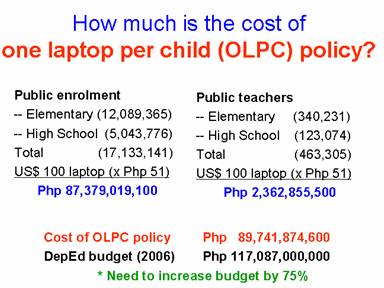
I have been following with great interest the development of the MIT $100 laptop project, as it seems to have good potential for developing countries. Benjamin Vergel de Dios, UNESCO Bangkok, made a financial simulation of the costs of equipping every child in the Philippines with a $100 laptop. As you can see in his diagram, it implies increasing ICT budget by a 75%, which is unfeasible for most developing countries. Benjamin is coordinating on an excellent project, called ICT in Education Policy, which aims to "promote appropriate policy models and strategies for the integration of ICT into education in the Asia-Pacific region, with special emphasis on developing policies which utilize ICT to remove barriers to participation in education and enhance the quality of education".

Image: Benjamin Vergel de Dios

Thursday, November 30, 2006

Augmented reality and mobile learning


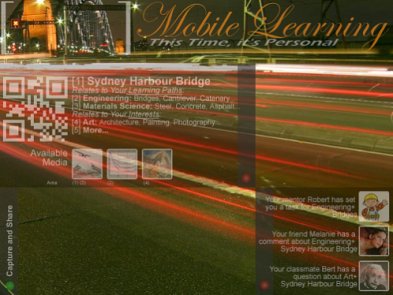
Leonard Low, who publishes the Mobile Learning blog recently posted an interesting concept for mobile learning interfaces. His idea is to have a flexible LCD screen which picks up location-based educational data via a mobile device. The student would then be able to access online resources and contacts according to his/her location, as an overlay of the view of the location itself.


As an aside, I think this is another illustration of the innovative nature of fiction - the overlay-style view he proposes looks rather similar to 'Terminator Vision' in James Cameron's 1984 Terminator movie.

Image by Leonard Low.

Thursday, November 23, 2006

Passively Multiplayer Online Games for Schools?


Howard Rheingold just blogged about Justin Hall's presentation at the University of South California's Annenenberg centre.

Howard wrote:
"Justin has fun online, works online, studies and loves and plays online -- and on his phone and his Playstation. Why can't the whole thing be a game -- a social game and a knowledge game? While he goes about his day's surfing, blogging, chatting, tagging, gaming, posting, uploading, downloading, Justin wants to experience the same visible sense of goal-oriented progress he gets in World of Warcraft when he looks at his screens and sees exactly what level his activities have earned him."

He also mocked up a screenshot using Jaiku, which I am using here to illustrate this post.

He also posted a link to a video (Quicktime) in which Justin explains the concept.

This kind of concept would also be great for learning environments, allowing users to understand how much progress they have made in different areas of their work. It's easy to see how it could be added to an LMS system such as Moodle for instance. Only problem is, it's inherently quantitative (i.e. will measure time and/or number of contacts, posts, etc) but would be unable to deal with qualitative aspects.

Wednesday, November 22, 2006

Social software and learning


Futurelab, a great UK-based research organisation working on many exciting research projects in education technology. It's launched a series of useful publications on current hot topics, called Opening Education . They recently published 'Social Software and Learning (PDF)', an excellent overview of social software, implications of such software for education, plus a plan of action for moving towards community-based learning.

Tuesday, November 14, 2006

Games in education


Computer games are becoming more and more popular in the educational world. UNICEF has just released Ayiti - The Cost of Life (via Water Cooler Games), a simplified 'Sims' style game where you assign tasks to family members living in Haiti. Even playing for just a few minutes communicates how difficult it is to balance health, education and finances when you are affected by poverty. Although I enjoy games, and see that they have some classroom uses, I think there's a lot of hype around them at the moment.

Obviously games have a lot of potential:
  • creating innovative interfaces for accessing educational content - mashing up Moodle with Second Life (SL) in Sloodle, so that content can be transferred and published on both platforms (more info on SL & education here)

  • increasing student motivation - using a new kind of interface can stimulate students' enthusiasm

  • improving hand eye coordination and reaction time - these are particularly crucial in fast-paced games.

I don't subscribe to the media hysteria of 'games are evil' (check out this interesting article on the topic from the Wilson Quarterly), I do see a number of issues in using games in education:
  • gender - navigation in virtual spaces has some gender issues; often boys find it easier to navigate due to more experience in game environments. Representation of gender roles in games can also be highly stereotypical, presumably because of the skewed gender representation in the technology industry

  • hampering creativity - some innovative games such as Sims and SL allow users to transform and create during the game. However, most still rely on users following one of a number of pre-determined paths, thus reducing creative opportunities.

  • difficulty and expense of game development - commercial games are now often more expensive to produce than Hollywood movies, and thus to produce an educational game of similar quality to the entertainment sector is prohibitively expensive.


More info about games in education:
Report from the Summit on Educational Games
University of British Columbia's virtual campus on SL
A collection of research papers on games in education on Citeulike
DoomEd - a first-person shooter game for science education.

Global nomads: video conferencing


An article in Edutopia covered the Global Nomads project, which aims to get teenagers to get in touch with their peers across international borders. The school pupils get to meet via video conference, and discuss crucial topics such as HIV/AIDS, global warming and war. But it's not all school work: the students also get a chance to ask questions about family life and hobbies. The website includes a media library of short films from Vietnam, Brazil, Japan and many other countries, and a schedule of forthcoming video conferences.

Tuesday, November 07, 2006

Lessons from an unusual social network

In the English speaking world, teenagers are all busy chatting to their friends on commercial social networking platforms, like MySpace (owned by News International) and Bebo. These platforms are full of advertising and offer little in terms of child protection or safety. Meanwhile many French speakers are using a rather unique platform, set up by a non-profit organisation, called Parano.be. Although it's based on rather basic technology (php), it has a huge number of users and survives on donations made by the biggest fans of the site. There is no advertising at all. Members join specific sectors based on their interests, which include sector-specific forums, bulletin boards and a number of other features. A virtual 'salary' is provided to users based on how long they stay online; the currency can be used to purchase virtual gifts or services for others, or even transferred directly to others' virtual accounts. The network is essentially organic: to invite a new member, you have to spend a relatively large sum of virtual currency to send the invite.

Here are some of the most intriguing features from an educational point of view:
- child safety is maintained. Under 18s can only join and view certain sectors of the site, which are monitored by older, verified individuals. Occasionally younger members will lie about their age, but the community usually swiftly responds. There is a high level of responsibility and self-policing. It shows that a school-based community could effectively be moderated by older children.
- role play (RP) is pervasive: although the interface is largely text based, RP is part of the life of most sectors on the discussion forums. The moderators organise an RP session on a regular basis, based on the suggestions of the members. These RP sessions are basically long stories generated by the contributions of each user, and can be highly imaginative. In education, such an approach would be great to encourage creativity and written expression.
- rank changes according to behaviour: the moderators assess the level of participation and other issues to understand what rank the members should have. Usually enthusiastic members will rapidly rise in rank, unlocking new features and 'missions' to complete. This is an interesting 'game style' approach which could encourage pupils to use a system.
- virtual currency is usually spent solidifying social links: buying virtual gifts such as champagne, flowers, teddy bears, etc. for others is really important in keeping good relationships with other members. Such a system could be used in a school-oriented scenario to help individuals understand money management and mathematics.
- games are common: individuals will organise games or competitions from their profiles. They could be treasure hunts, to find information hidden on others' profiles, or simple trivia questions. Prizes are usually virtual currency or gifts. This ludic atmosphere could easily be transferred into an educational 'quest'.

Friday, November 03, 2006

Football, global thinking and ICT in the holidays


The Communication Initiative recently published an article which alerted me to Bring on the World, a pack of excellent ICT-based resources for informal education activities for school breaks. Using the World Cup as a basis for exploration, this pack of activities released by Oxfam helps children to think and learn about fair trade, globalisation, Millenium Development Goals and other huminatarian topics. At the same time, the activities are linked to the UK curriculum, as they involve PE, English (reading and writing), Geography, Citizenship and ICT.

Picture from Oxfam website.

Thursday, November 02, 2006

Open source learning resources repository


Not all schools or other educational institutions need or want to install a learning management system (LMS), but a learning resource repository is extremely useful for keeping track of digital learning resources and better enabling sharing between teachers and learners. European Schoolnet has recently released MINOR, an open source "repository to store, manage, and exchange the multimedia assets produced by teachers", as it says in the news article they recently published. The application and source code can be downloaded from Sourceforge.

eLearning for developing countries: what's needed?


Despite many good intentions for developing countries to 'leapfrog' in technical terms, it is rarely yet the case. In many ways, this is because most technologies are designed and deployed in a developed country context, and thus have a number of limitations when trying to implement in a developing country. Additionally, many developing countries still don't have many specialists in ICT in education, and rely mainly on the precious few of enthusiastic, over-worked, pioneering teachers to drive change in their schools.

My work in SE Asia and Europe has prompted me to identify some issues which might help developing countries to deploy more cutting edge technologies in schools, despite the status quo of low bandwidth, poor infrastructure, low levels of training and support for teachers.

1. LAN-based Learning Management System (LMS) installation

many LMS have excellent features which would help schools in developing countries to make best use of their low levels of connectivity and relatively few ICT-based resources. Using an LMS with some learning content management features on a LAN is a good solution for enabling teachers to effectively share their 'homegrown' as well as externally acquired ICT resources. In addition, using LMS tools would enable students to get a 'feel' of using Internet-style applications without the need for broadband connectivity.

What are the barriers? Cost (especially in the case of commercial LMS), difficulty of installation (particularly in Open Source LMS), need for low cost LMS on appropriate platform (many low cost LMS run on Linux, which many teachers find hard to install).


2. Platforms based on mobile phone technologies

Many developing countries have very low numbers of PCs in schools, and low connectivity. However, many people are using mobile phones, and I have seen that many teachers have their own. In Thailand for instance, many people have mobile phones with quite advanced features. There is clearly potential for using mobile phones for teacher support and networking - e.g. sharing lesson plans, tips and advice. My previous post on mobile learning has other ideas.
What are the barriers? Lack of models for use of such platforms, lack of knowledge among teachers in installing/configuring such platforms.

3. Platforms with a range of content creation and synchronisation options
Due to low connectivity, schools in developing countries can benefit from platforms which can deal with offline content creation, which can synchronise/upload/download new resources and other content in a batch process. Surely RSS/XML technologies can handle this rather easily.
What are the barriers? Barriers are almost non-existent. Are there platforms out there already which have these capabilities?

4. Open content repositories with language agnostic approach Many educators in developing countries say that there is little content available in their languages. However, there are huge amounts of language-free content online in the form of pictures, maps, small sound files and other non-textual forms. But teachers and students cannot find such content due to the lack of index and search tools available in their own languages. It would be great to see more organisations taking a FOSS/OER approach to translating at least search interfaces in minority languages.
What are the barriers? Lack of capacity within developing countries to take the initiative on such issues, lack of awareness in developed countries to make such facilities available.

5. Training in dealing with low ICT infrastructure scenarios Many teachers in developing countries seem to think that they can only really use ICT if they have one or two pupils per computer in the computer lab. There are many strategies for using ICT without having a good level of infrastructure. For instance, I saw in one training session, Chris Smith using just one keyboard and mouse together with a projection screen to engage a whole group. Basically, one person controlled the mouse, and another the keyboard. Both were passed around the room so that everyone used the equipment during the session - the only additional investment needed was a very long (but cheap) cable! Other strategies such as using web applications on a LAN, backing up websites using tracker programes (like HTTracker) so they can be browsed offline when Internet connection is slow or disconnects often. There are many other strategies, but hardly any training or training content for teachers on this topic.
What are the barriers? Most training is planned still with an "ideal" situation in mind rather than a realistic view of the state of schools. Better needs analysis should be done when planning training.

Tuesday, October 24, 2006

What MySpace can teach education technologists


MySpace, the site that most Western teenagers use every day, but also love to hate. It has so many problems and issues, but nonetheless continues to grow in popularity. Perhaps there are some lessons we can learn for education technology projects.

1) Users can tolerate bugs: Myspace is bug-ridden. This morning I had to log in 10 times to subscribe to a friend's blog. But people still go there every day..
2) All that matters is the people: Most users only stay on MySpace because their friends and useful contacts are there.
3) Safety is not assured: although still affecting a relatively small number, safety concerns are high (as anyone can register, and say they are any age). So adults can send unsuitable content to children.
4) Privacy worries: teens are posting unsuitable content, without thinking about the consequences. There's clearly need for more media literacy education here.
5) Usability isn't such a big deal: the MySpace interface is very inefficient and requires far too much clicking to do some simple tasks. But they still go back...
6) Corporate ownership doesn't worry them: teens are uploading creative work to the MySpace platform without any concerns about ownership.

US researcher Danah Boyd has written a great deal about MySpace and similar social networks. Also my previous post on digital teenagers has some discussion of similar issues, and a link to an audio file which includes teens talking about MySpace.

Friday, October 20, 2006

Digital teenagers


A recent post on David Warlick's 2 Cents Worth blog pointed me in the direction of a recorded interview with a bunch of American teenagers about their Internet habits, which took place at the 2005 web 2.0 conference. I found it particularly interesting, as I realised that my own Internet habits were pretty similar to the teenagers. Here are some of the main points that struck me:
- teenagers spend a great deal of time on MySpace or similar social networks. I visit MySpace once daily, although don't spend as long on there as they do - but I'm using alternative spaces for similar activities.
- they are really into IM, via whatever interface is used by most of their friends. I only recently managed to get off IM (mainly to save myself time, as I often got into distracting conversations in the middle of the day), although in a previous job I used IM extensively to chat with web developers
- they don't want to pay for things, and use P2P networks on a regular basis. Me too!

My conclusion is that we need to look more into the following areas in education:
- Internet safety for teens: how to protect them through education and media literacy
- IM for education: there are obvious applications in language teaching (linking up pairs of students across borders to chat in second languages) but how else could it be used?
- P2P educational resources: in education, we often say that we want teachers to share resources, but still put up barriers to students doing this. Shouldn't we allow students to share/learn from each other in this way too?

Wednesday, October 18, 2006

Postcode plants database


The UK's Natural History Museum offers this excellent resource for the UK. You simply fill in the first part of a UK postcode in the search box, and the database returns a list of native flora from that area. The species are listed under both common and scientific names, and clicking on the species gives a few additional details such as the family, form, provenance and in many cases, some photographs. The database could inspire many different educational activities, such as comparing and contrasting species found in two or more areas of the country, providing a "jumping off" point for outdoor investigations, where children could map the frequency and location of particular species in the local area. The possibilities are really only limited by the imagination. Unfortunately the database is copyright to the Natural History Museum - it would be great to see this as a Creative Commons licensed resource. It's a nice initiative that could be widened to a global scale.

Update (19/10/2006): this morning I read Stephen Downes' post, re-emphasising the value of P2P infrastructures compared to client-server approaches. It made me re-think the value of this kind of postcode database. It would be even better if there were open contribution databases, with feeds which could be federated into one... Then, students could be contributors and constructors of the resource, rather than just users.

Google and Oracle make further moves in education


Both companies have recently announced new initiatives for education. Google have partnered with a number of educational organisations (mostly US based) to provide examples and advice for teachers around a number of their tools. They now have a specific website for educators bringing together the tools and content.


Meanwhile the Oracle Academy has a new curriculum for secondary school students in advanced ICT, and new training materials for teachers. There is an overview (PDF) posted on the site. It seems like a more formal approach to complement the existing informal learning project I previously blogged about, Thinkquest.

Photo by Marvin.

Tuesday, October 17, 2006

Thinkquest Thailand


Oracle's Thinkquest competition for students is taking place again this year. So far, only one Thai team has taken part in the past. This year, three teams will join in the competition, and thanks to Dr. Rangsun at the Thai Bureau of ICT, I have the chance to support them. Dr. Rangsun organised a great one-day workshop, where the teams of students and teacher-coaches presented their ideas so far, and received constructive criticism from Oracle experts, Dr. Rangsun and myself. Now, the teams are supporting each other via a discussion list. I look forward to seeing the results!

Friday, October 13, 2006

Making connections through images: Memory Project


No Man's Blog recently introduced me to the Memory Project, a really wonderful small-scale project linking high school students in Western countries with disadvantaged kids in developing countries. The high school students are studying art, and are asked to make a portrait of their distant counterpart. As it says on the site/
"Given that children who have been abandoned, neglected, abused, or orphaned usually have few personal keepsakes, the purpose of the portraits is to provide them with a special memory of their youth and to help honor their heritage and identity".

It would be great to see this project enlarged, so that there is a long term means of contact between the two groups. Adding an ICT-based element for maintaining contact would then also act as an informal training mechanism for the children in the developing country.

Thursday, September 21, 2006

Mobile learning


I've often thought that mobile learning is going to be an even more exciting development than traditional eLearning. Even in developing countries, mobile phones are well used (here in Thailand, I'm often embarrassed by how old my phone is compared to the young people on the SkyTrain). So their potential for unlocking a much more accessible approach for education is huge.

There is some interesting work going on in Europe, based on mobile phones. Lots of ideas are flying around like pervasive educational games for pupils, on-demand tutoring/mentoring for university students, making interactive location-based content using the mobile version of the Flash application...

There is a good research project, called emapps.com which has among its goals:
  • "adaptable interactive tools (primarily games played on a mobile platform) with which to deliver learning objectives and which help to integrate the use of ICT in the delivery of the school curriculum;"

  • "to build communities of creative, networking children in the NMS, generating their own cultural content and communicating with peer groups in other countries"

  • "to make the multilingual and multicultural local content created during the games to be shared and repurposed for use in the wider eLearning context of schools and children".


Futurelab is an excellent UK research centre for ICT in education. They have produced a report called "Literature Review in Mobile Technologies and Learning" which includes a number of casestudies.

Ericsson, the mobile phone company is doing some research on m-learning, and offers a nice overview presentation (PDF) and also an update on main EU activities in this area.

Mobilearn is a large scale EU project led by Giunti(an Italian LMS & multimedia company). The project has made available a great deal of handy resources.

Finally, I also came across Mobile Learning, a good blog keeping up to date on the issues.

Update (17/10/2006): I met with Teemu Leionen from FLOSSE Posse in Bangkok a few weeks ago, and he let me know about the MobilEd project, which is doing some interesting experiments using mobile wikis in low connectivity contexts in S. Africa.

Update (3/11/2006): Howard Rheingold recently posted about free mobile phones for teenagers supported by advertising in Finland. It would be interesting to see a similar initiative in developing countries.

Photo by Donknuth.

Tuesday, September 12, 2006

Open content for education


Educational content is still too expensive and inaccessible for many developing countries, whether it is digital or traditional. As connectivity rates increase dramatically, it makes sense to prepare digital materials for these newly connected educational institutes, teachers and young people. There are a number of interesting projects worldwide to do this, including the Global Text Book project, aiming to "create a free library of 1,000 electronic textbooks for students in the developing world". These textbooks will cover areas typically included in the first two years of undergraduate study - I'm sure many developed world students will use them too.

Another interesting approach comes from the Centre for Open and Sustainable Learning, part of the Utah State University in the USA. They are involved in a range of projects such as Creative Commons for Education, creative learning environments using advanced visualisation, and open course ware (OCW). Even better, all their materials are CC licensed too.

Wikieducator is also part of the whole open content movement, acting as a hub for those interested in this area. The portal itself hosts free content for education, and the people behind it network to find ways of funding open content projects. Meanwhile the Bazaar is a similar approach, but a wider scope, as it's a community for exchange and use of both open content and free & open source (FOSS) software.

The University of Art and Design Helsinki has recently collaborated with UNESCO to offer the Young Digital Creators kit, a free kit for schools and other educational organisations, which includes a variety of approaches, tips and more for helping young people to make creative content. To support the activity, the kit includes a number of FOSS tools. UNESCO also has another project for producing CDs of FOSS tools and open content for education, which I previously blogged about here.

Finally, the mother of all open content projects, Creative Commons has a great archive of materials and useful advice for licensing your content in more open ways.

Update (24/10/2006): UNESCO's Virtual University project hosts a number of online discussions of Open Educational Resources for Higher Education.

Friday, September 08, 2006

Learning Management Systems: the next move


As usual I've been keeping my eye on the current research in Learning Management Systems (LMS) and their other incarnation, Personalised Learning Environments (PLEs). I recently came across this article - Social software: E-learning beyond learning management systems - which unifies two areas I'm into: social networks and LMS. As a student, I have used a very basic LMS, but really only for accessing archived materials put online by tutors. As a real-life learner, I don't really use LMS-type software but I do use social networks and I'm an avid consumer of all collective intelligence-type stuff like Diigo and Technorati. However, all this changes week to week. If we take into account multiple intelligence theory, and combine this with the budget limitations faced by education, it becomes clear that a really good PLE is probably not achievable, unless the student has almost infinite control on the look and feel (or even sound!) of the PLE, the speed of new data update/transfer (for instance I love to be interrupted, I find it inspiring, while others find it counterproductive) and even the kinds of communication tools he/she needs.

But do we need one unified system to provide all this? Or should we just be flexible and open to the needs of individual students? On one hand, the unified system is attractive because it is safe and controllable, but this also limits its flexibility and potential. Meanwhile, a truly open 'free for all' approach can customise for any student, but is likely to be low on child protection and guidance for those who need it. Maybe the answer is we need both?

In any case, in a developing world context, the whole debate is still more open, as few schools are using LMS. Some well-off universities have bought into commercial LMS like Blackboard, but it's really the exception. So, should we be advising developing countries to implement LMS? The concensus here seems to be that we should, and probably focus on Moodle as it is relatively low cost. But for a small school, with low numbers of computers, this is surely overkill and it's better to look at a PLE type setup.

Photo by Alexa Joyce