At the EU Media seminar, one of the speakers showed this amusing video to raise awareness of children's web-use among parents.
Friday, May 11, 2007
Thursday, May 10, 2007
Protecting children vs. free speech

Over the years I’ve attended a lot of EU events focusing on children’s use of and behaviour on the internet. One issue that is rarely raised in these EU events is the unfortunate tension between child protection and free speech. Many experts in the EU advise using filtering and blocking tools in particular with young children, who might be exposed to ‘harmful’ content on the web.
Although I understand their concerns, I worry about the EU funding development of such tools, mainly because research in this area is easily repurposed by governments to restrict freedom of speech and access. For instance, these technologies are used by China for it’s ‘Great Firewall’ (euphemistically termed the ‘Golden Shield’) and Burma to block access to controversial or critical websites. Indeed, Thailand recently blocked YouTube across the country, due to the posting of some rather silly but obviously critical videos about the King of Thailand.
At the same time, many free speech activists are constantly developing tools that allow users to subvert controls and filters; any smart kid could search for them on Google and thus subvert parental controls. Reminds me of the famous Star Wars quote: “the more you tighten your grip, […] the more […] will slip through your fingers.”
It’s a difficult issue, which I hope to raise today during the working group being chaired by Sonia Livingstone at the EU expert media seminar.


Friday, May 04, 2007
Google Earth: Crisis in Darfur

I've been following the development of Google Earth with a lot of interest, as it's a great tool for supporting teaching and learning of Earth sciences, biology and geography. Recently Riina Vuorikari pointed out this impressive application, developed by the United States Holocaust Museum and Google. It mashes up data from Google Earth, personal testimonies and maps of settlements from the UN Office for Coordination of Humanitarian Affairs. It's unbelievably striking in conveying the impact of conflict, in a way that we can't grasp via TV news. Take a look.
Thursday, May 03, 2007
Tim O'Reilly on Education 2.0

"Tim O'Reilly is the founder of O'Reilly Media, and one of the originators of the phrase 'web 2.0" writes Steve Hargadon, to introduce his audio interview with Reilly himself.
He talks a great deal about exploratory learning, small class sizes and 'free data'.
 Listen to the the Interview in MP3 format
Picture: from the O'Reilly website.
Setting up a new school in Cambodia

A previous colleague and now friend John Denny is setting up a new school in Cambodia. I asked him a few questions about what he's up to.
What kind innovative uses of ICT are you putting in place?
"To be honest from my perspective none! But from a Cambodian perspective we are modern as I am pushing all aspects towards digital communications, such as a computer in each classroom. Instead of typical cassette tape listening methods we will use computers to play CD or MP3 versions. Students can then compile listening lessons in MP3 format to play back as they please or cut a CD for home use. I do hope to get some some basic recording equipment so we can upload digital lectures, yet at present stage Internet costliness is a major block in Cambodia as they tend to charge by the MB downloaded. Our school is one of the first to use an unlimited broadband line! We have a satellite connection beamed in from one of [Thaksin - ex-PM of Thailand] Shinawatra's floating beasts. Thus I will encourage massive downloading - something new for Cambodians."
What's been the biggest challenge in setting up the school?
"First I thought it was to create a unique identity as language schools are a dime a dozen here. Thus it has taken considerable thought coming up with a doable plan that will attract students while giving them the security they need. We intend to offer a quality program second to none."
"On second thought offering a quality program is a struggle. Getting highly motivated teachers, school staff and connected issue of creating a ""culture of quality" institution-wide is not an easy task. It is a major struggle dealing with my developed world sensibilities versus the reality that in a post-conflict country things simply do not and cannot work the way one knows they should."
What would be the dream 'killer app' for helping the school, whether pedagogical, admin or something else?
"That's an easy one. I am dying to get a web-based open source school management app installed and configured. My target is OpenAdmin, if that fails Focus/SIS or CLaSS. Whatever it is, I am desperate to consolidate all school management function in one web app. Yet the bigger struggle is to get largely non computer literate staff members to understand the importance and buy-in after it is installed."
What's the local reaction like?
"So far we have distributed about 10,000 brochures. I was instrumental in totally reconfiguring the marketing strategy set by our school director. Instead of paying media corporations to advertise our school I convinced the team to advertise for commission-based sales representatives. These sales reps are given brief training on school selling points then set afoot to broadcast the message. Any student enrollment generated by the sales rep then brings them a 10% sales commission. After bringing in 6 students a sales rep is awarded an extra bonus or the chance to enroll for free in any of our course offerings."
"As per several of the highly motivated sales reps the reception is excited and enthusiastic as they can see via our brochure that this school strives to be different, is going to be a value added experience -- the type of place where students come to develop a lifelong experience in learning and sharing ( i.e. 3 NGO's on premises; special workshops, lectures and seminars, free overseas study advise, free software distribution, etc...)"
The website is still under construction, but visit: http://www.princeacademy.org
Teaching the machine
Short and sweet video on web 2.0, by Mike Wesch, a researcher who is currently working on an ethnography of YouTube.
Update (10 May 2007): I'm now at the EU Media Expert seminar in Leipzig, and the AOL speaker is showing this video in the plenary session!
Friday, March 23, 2007
Insafe: mobiles at school
Right now I'm at the Insafe Training Meeting for the European network of Internet safety awareness nodes, being held in Vienna. It's been an interesting event, discussing around issues to do with children's media use. Annie Mullins, the "Internet hero" presented some interesting new and planned features for customising mobiles to the age of the child involved.
In a brief chat after her presentation, we agreed that the education system really needs to integrate mobile phones into teaching and learning. This will enable more media literacy activities around mobile use, and hopefully help to combat cyberbullying issues. The staff from children's helplines mentioned that cyberbullying is one of the major topics concerning kids now in their use of media. Maybe we don't spend enough time on 'netiquette' and mobile etiquette in schools, and parents often feel unable to deal with it.
In a brief chat after her presentation, we agreed that the education system really needs to integrate mobile phones into teaching and learning. This will enable more media literacy activities around mobile use, and hopefully help to combat cyberbullying issues. The staff from children's helplines mentioned that cyberbullying is one of the major topics concerning kids now in their use of media. Maybe we don't spend enough time on 'netiquette' and mobile etiquette in schools, and parents often feel unable to deal with it.
Friday, March 02, 2007
Innovative Teachers Conference in Siam Reap

UNESCO and Microsoft recently co-organised a conference for teachers in Angkor Wat, a beautiful World Heritage site in Siam Reap, Cambodia. The concept is really exciting, as it brought teachers to this amazing location, to work together in international teams to produce ICT-based teaching and learning materials, focusing on Angkor Wat as a theme for introducing other curricular areas such as arts, science and environment. More info on the UNESCO website and UNESCO Bangkok website.
Photo by TylerDurden.
Wednesday, February 28, 2007
Open educational resources: overcoming the obstacles

I recently moderated a UNESCO online discussion, with Susan D'Antoni (UNESCO IIEP) and Jan Hylen (OECD) on open educational resources. The expert group looked in detail at an OECD study of OER, and made many suggestions and recommendations for enhancing and stimulating OER production. My finalised discussion report is now available for download.
Photo by Jek in the box.
Friday, February 16, 2007
Young people struggle to maintain their privacy online

Latest results from a survey of young people I launched in December: "57% of young people make their online social network profiles public and disclose a great deal of personal information, according to a recent survey of 21,872 people across Europe organised by European Schoolnet, coordinator of European Insafe network. Almost a third of youngsters responding indicated that they didn't know what to do about making information public or private. However, in other areas, awareness of safe behaviour is increasing."
Read the full press release. A full report on the survey of young people will be released around the end of March.
Thursday, February 15, 2007
Peacemaker: a game for peace

Peacemaker is a computer game based on the Israeli-Palestinian conflict. It's aim is to "promote dialogue and understanding among Israelis, Palestinians and interested people around the world". The player has to find a route to peace, navigating through events such as suicide bombs, military attacks and diplomatic negotiations. Much of the game is based on real video footage, and has relied on university academics for their knowledge of the region and realism.
Watch the demo video
Tuesday, January 23, 2007
Open Access eLearning Papers

eLearningEuropa.info, a European portal for ICT in education, has recently launched a new open-access, Creative Commons-licensed journal called eLearning Papers. The second volume (PDF) is now available for free download, while you can browse individual articles and papers on the site. Great to see an open approach being used by a publicly-funded project, and ties in nicely with the recommendations of the participants in the UNESCO-OECD forum on OER I led recently. Another archive of eLearning papers is available via TeLearn (see my previous post).
Safer Internet Day: global blogathon

Safer Internet Day is taking place on 6 February 2007. More than 200 schools and 150 organisations are taking part in the event via a global ‘blogathon’ and competition for creating digital materials on ePrivacy, Netiquette, Innovation and the Power of Images.
Starting as an initiative in 2004, SID has become a major annual event crowning the awareness activities of Insafe, the European safer internet network coordinated by European Schoolnet.
Schools will showcase their creations in the 2007 Blogathon: a blog that opens every year on SID. On 6 February, 4 winners will be announced and receive prizes of ICT equipment for the schools worth a total of 3,000 euros. At the same time, the blog will be opened to participating organisations, who will each post messages on the topic of ‘crossing borders’ from all over the world.
Also on SID a press release will be issued including the first data from my survey of children's behaviour when using ICT tools such as mobile phones and social networking platforms.
Wednesday, December 06, 2006
Open archive of education technology research

I4D recently wrote about TeLearn, an open archive of technology-enhanced learning research articles. TeLearn is offered by Kaleidoscope, a "European research network shaping the scientific evolution of technology enhanced learning", funded by the European Commission.
Friday, December 01, 2006
One laptop per child is unfeasible for developing countries
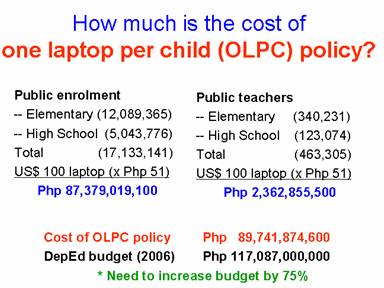
I have been following with great interest the development of the MIT $100 laptop project, as it seems to have good potential for developing countries. Benjamin Vergel de Dios, UNESCO Bangkok, made a financial simulation of the costs of equipping every child in the Philippines with a $100 laptop. As you can see in his diagram, it implies increasing ICT budget by a 75%, which is unfeasible for most developing countries. Benjamin is coordinating on an excellent project, called ICT in Education Policy, which aims to "promote appropriate policy models and strategies for the integration of ICT into education in the Asia-Pacific region, with special emphasis on developing policies which utilize ICT to remove barriers to participation in education and enhance the quality of education".
Image: Benjamin Vergel de Dios
Thursday, November 30, 2006
Augmented reality and mobile learning
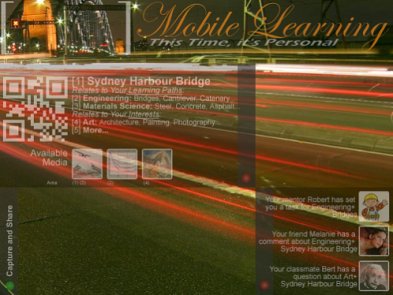
Leonard Low, who publishes the Mobile Learning blog recently posted an interesting concept for mobile learning interfaces. His idea is to have a flexible LCD screen which picks up location-based educational data via a mobile device. The student would then be able to access online resources and contacts according to his/her location, as an overlay of the view of the location itself.
As an aside, I think this is another illustration of the innovative nature of fiction - the overlay-style view he proposes looks rather similar to 'Terminator Vision' in James Cameron's 1984 Terminator movie.
Image by Leonard Low.
Thursday, November 23, 2006
Passively Multiplayer Online Games for Schools?

Howard Rheingold just blogged about Justin Hall's presentation at the University of South California's Annenenberg centre.
Howard wrote:
"Justin has fun online, works online, studies and loves and plays online -- and on his phone and his Playstation. Why can't the whole thing be a game -- a social game and a knowledge game? While he goes about his day's surfing, blogging, chatting, tagging, gaming, posting, uploading, downloading, Justin wants to experience the same visible sense of goal-oriented progress he gets in World of Warcraft when he looks at his screens and sees exactly what level his activities have earned him."
He also mocked up a screenshot using Jaiku, which I am using here to illustrate this post.
He also posted a link to a video (Quicktime) in which Justin explains the concept.
This kind of concept would also be great for learning environments, allowing users to understand how much progress they have made in different areas of their work. It's easy to see how it could be added to an LMS system such as Moodle for instance. Only problem is, it's inherently quantitative (i.e. will measure time and/or number of contacts, posts, etc) but would be unable to deal with qualitative aspects.
Wednesday, November 22, 2006
Social software and learning

Futurelab, a great UK-based research organisation working on many exciting research projects in education technology. It's launched a series of useful publications on current hot topics, called Opening Education . They recently published 'Social Software and Learning (PDF)', an excellent overview of social software, implications of such software for education, plus a plan of action for moving towards community-based learning.
Tuesday, November 14, 2006
Games in education

Computer games are becoming more and more popular in the educational world. UNICEF has just released Ayiti - The Cost of Life (via Water Cooler Games), a simplified 'Sims' style game where you assign tasks to family members living in Haiti. Even playing for just a few minutes communicates how difficult it is to balance health, education and finances when you are affected by poverty. Although I enjoy games, and see that they have some classroom uses, I think there's a lot of hype around them at the moment.
Obviously games have a lot of potential:
- creating innovative interfaces for accessing educational content - mashing up Moodle with Second Life (SL) in Sloodle, so that content can be transferred and published on both platforms (more info on SL & education here)
- increasing student motivation - using a new kind of interface can stimulate students' enthusiasm
- improving hand eye coordination and reaction time - these are particularly crucial in fast-paced games.
I don't subscribe to the media hysteria of 'games are evil' (check out this interesting article on the topic from the Wilson Quarterly), I do see a number of issues in using games in education:
- gender - navigation in virtual spaces has some gender issues; often boys find it easier to navigate due to more experience in game environments. Representation of gender roles in games can also be highly stereotypical, presumably because of the skewed gender representation in the technology industry
- hampering creativity - some innovative games such as Sims and SL allow users to transform and create during the game. However, most still rely on users following one of a number of pre-determined paths, thus reducing creative opportunities.
- difficulty and expense of game development - commercial games are now often more expensive to produce than Hollywood movies, and thus to produce an educational game of similar quality to the entertainment sector is prohibitively expensive.
More info about games in education:
Report from the Summit on Educational Games
University of British Columbia's virtual campus on SL
A collection of research papers on games in education on Citeulike
DoomEd - a first-person shooter game for science education.
Global nomads: video conferencing

An article in Edutopia covered the Global Nomads project, which aims to get teenagers to get in touch with their peers across international borders. The school pupils get to meet via video conference, and discuss crucial topics such as HIV/AIDS, global warming and war. But it's not all school work: the students also get a chance to ask questions about family life and hobbies. The website includes a media library of short films from Vietnam, Brazil, Japan and many other countries, and a schedule of forthcoming video conferences.
Subscribe to:
Posts (Atom)
